Instrument

cello bow
Dodd Family
London
played by
Emma Warmelink
Emma Warmelink

*1705 , Sheffield (Edward Dodd) †1865 , Londen (James Dodd II)
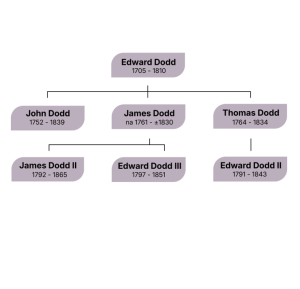
What is known about the first and second generations of Dodd bow makers comes from early English biographical accounts and oral traditions. This was often driven by the desire for an English counterpart to the great French bow makers, as well as a certain embarrassment over the fact that most of the Dodds had been unable to rise above the slums of the capital. James was often overlooked; he was celebrated for the magnificent bows he had sent to the World’s Fair, but there was no certainty that he had actually made them himself. Baptismal or marriage records and registrations with churches in Lambeth, Covent Garden, and Southwark—or with a guild—are virtually nonexistent.
Edward Dodd was presumably born in Stirling, Scotland, where he worked as a gunsmith. Some sources mention that he was already making bows there. His three sons—John, James, and Thomas—were born there, although their birth certificates are missing. Tradition has it that Edward moved to Northumberland for a short time. Ultimately, London was where the entire Dodd family settled.
‘Lambeth: workshopin an industrial slum’
Edward’s first workshop, which he opened in London around 1770, was located on Paradise Road in the Lambeth district. The neighborhood consisted of brick houses originally intended for small-scale cottage industries, but by the end of the 18th century it had become an industrial, severely overcrowded slum, blackened by the smoke from pottery workshops that burned lignite. Life expectancy there was short, and living conditions were poor. For this reason, after a few years, Edward moved to Salisbury Court, near Fleet Street, which was a bustling commercial area in the old part of London with small theaters and many printing shops. In 1810, Edward died at the age of 105. His death certificate from the St. Bride’s parish stated that “old age” was the cause of his death.
John stayed in Lambeth. The surrounding neighborhood was home to many musicians and a few up-and-coming music publishers. The violin was inexpensive and popular there, played in pubs, on the streets, or in living rooms. Amateurs played arrangements of opera excerpts or the popular trio sonatas by Corelli and William Boyce. The large numbers of Scottish and Irish immigrants living in these working-class neighborhoods brought their own violin traditions with them. At the same time, literary giants such as William Wordsworth and John Keats could often be found in the coffeehouses around St. Bride’s Church.
John Dodd was Edward’s eldest son and was born around 1752. His parents were likely still living in Stirling, though some sources mention Northumberland. In 1770, he moved to the area near Edward in Lambeth and found a job as a “gunlock fitter.” This was a precision-engineering trade in which he had to assemble the parts of dueling pistols. He also crafted the wooden stocks into which the metal parts were fitted. A “fitter” had to adjust these so that the entire mechanism functioned flawlessly. The most expensive pistols were often inlaid with silver. He later applied his skill in melting and working with silver to the craft of bow-making. Lacking new silver for his bows, he melted down spoons and used the silver for the bow sleeve and the end plate.
Biographers often cite Dr. William Sellé, a violinist who knew John Dodd personally. He mentions Whitechapel as the place where John Dodd began working as a gunlock fitter. It was located near Lambeth and was home to many gunsmiths. After a few years, he continued his career as a maker of precision scales, only to become a bow maker sometime between 1780 and 1785. He never had a teacher.
‘Unique andto some extent eccentric’
In London, there was a brisk trade in violins from both home and abroad. As a result, there was a high demand for bows. Most violin makers produced bows as an accessory; there was hardly any specialized expertise in this field in England. When Italian violins became popular in England, they required bows with characteristics that the English were unable to produce.
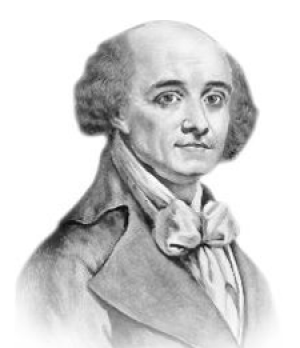
Giovanni Battista Viotti (artist unknown)
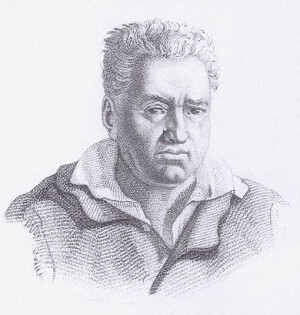
François Xavier Tourte, engraving by J. Frey (1818)
The violin virtuoso Giovanni Viotti played a role in that transition that can hardly be overstated. He was friends with the Parisian bow maker François Tourte and had even collaborated with him on innovations in bow design between 1785 and 1790. One of his own bows was the result of that collaboration. Its playability and responsiveness were unmatched for that era. With it, Viotti was able to further develop his new playing style, which eclipsed that of his contemporaries. Equipped with Tourte’s new bow, Viotti took the English music world by storm. He made his debut in London in February 1793, and the newspapers wrote that he had given the music a soul. A year later, he was acting director of London’s Kings Theater.
When France was engulfed in the turmoil of the French Revolution in 1789 and under Napoleon’s subsequent rule, England found itself virtually cut off from new ideas about musical practice in France and Italy. Viotti fled to England and became director of the King’s Theatre in 1797. When the war ended in 1814, the English realized that, when it came to bow-making, they were a generation behind the French.
At some point during the war, John Dodd must have acquired a bow made by François Tourte. He moved to the more rural town of Kew, just outside the bustling heart of London, and began making a similar model there, though he continued to craft the frog in the English style. From there, he sold them to violin makers in the city through his intermediary and dealer, John Norris, who stamped them with his own mark. The story goes that when asked to reveal his secret, he replied, “Not even for 1,000 pounds.” Norris died in 1818. Due to suspicion, alcoholism, and a lack of business acumen, John soon fell into poverty; Dodd refused to share his methods with students, so he died without any students or a successor.
‘The sound of jingling shells could be heard in his pants pockets—shells he had begged for at market stallsto use as mother-of-pearl parts’
His biographers have portrayed John Dodd as a brilliant but alcohol-plagued man who had the distinction of inventing the modern, concave bow. It was only when it emerged that Viotti had brought such a bow from Tourte to England years earlier—and that it had served as a model for John Dodd—that history had to be rewritten.
His contribution to the craft was something he had kept secret for a long time: he used a device with two saw blades that allowed him to cut the bow, curve and all, directly from the wood. The French bent the pernambuco under heat and pressure. That method allowed for very precise adjustment. The result of John’s method was that the bow was stable but less responsive. John’s work was innovative but not very popular among English musicians. For that reason, he still made many of his bows in the old English style, with an open bottom without a slide or ferrule.
“Unique and, to a certain extent, eccentric,” is how the violinist and family expert William Sellé described him. He was illiterate and, in his final years, lived off of handouts. John drifted from one address to another in London before ending up at the Long Hill workhouse in Richmond. That institution was maintained by the parish of Richmond and included a “House of Correction” and several poorhouses. John Dodd died there of bronchitis in 1839, after which he was buried in Kew.
Throughout history, John had been credited solely with the family’s fame, but it was his youngest brother, Thomas (1764–1834), who turned out to be the family’s commercial driving force. His career began at a brewery, where he bent wood and made barrels. He may have learned how to make bows from John, but that is not certain. It was not until he was about twenty, in 1784, that he moved to Southwark, where he spent ten years making bows for others on Blue Bell Alley.
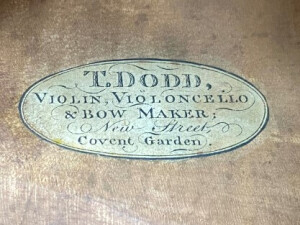
Photo courtesy of Ellen Broughton Photography
In 1794, he settled on New Street in Covent Garden, where the aristocrats had left and the neighborhood around New Street had been transformed into a bustling commercial area full of coffeehouses, taverns, shops, and brothels. But there was also a musical instrument shop owned by William Campbell. In addition to being a merchant, Campbell was also a publisher of sheet music and dance books. His work was closely tied to the social life of the London elite, who used his dance collections for their balls and parties.
He had been selling Thomas’s bows for several years, and when Campbell opened a new shop elsewhere, Thomas Dodd took over the store on New Street. He expanded it to include a violin-making workshop and began dealing in stringed instruments. With the help of skilled violin makers such as B.S. Fendt and J.F. Lott, he was able to afford a larger building on the fashionable St. Martin’s Lane in 1809, not far from the art academy of the same name. Starting in 1813, Thomas also sold harps, pianos, and bows made by John and other family members.
Over the years, Thomas proved to be more of an entrepreneur than a craftsman. But he was certainly someone with an exceptional eye for quality. The cellos and double basses that Thomas sold were comparable to the finest instruments made by French or Italian luthiers. One of the most important violin makers whose instruments Thomas sold was Vincenzo Panormo. This Italian luthier had settled in London and brought the Italian tradition of violin making to England. The small violas built by others under the name of Thomas Dodd also contributed to his success. His network was so strong that even James Tubbs allowed him to sell his bows.
‘InstrumentsImproved andRepaired’

Visitekaartje Thomas Dodd © The Trustees of the British Museum (shared under CC BY-NC-SA 4.0 licence)
Thomas Dodd also imported instruments from Italy. To evade taxes, he sometimes did so in separate parts, which didn’t always go well. This resulted in combinations that weren’t originally intended. He sometimes had old Italian instruments modified and then replaced the labels with those of makers who commanded higher prices. In the twentieth century, such an instrument was mistakenly identified as an early composite.
He advertised in newspapers with “Perfect Copies of Stradivarius (or Stainer, Amati, etc.)” and, according to his own claims, sold “Instruments Improved and Repaired.” The varnish he used was “based on a Cremona formula.”
In 1813, Thomas purchased a second store at 3 Berners Street, also in Whitechapel. Beginning in 1810, the nearby London Docks were expanding rapidly, and Berners Street became populated with porters and immigrants. His son Edward joined the business and opened a department where he sold pianos and pedal harps—which were very popular at the time—and had over 900 of them built under his own supervision. By 1838, the business was registered as “Dodd & Sons.” Edward proved to be highly gifted technically and, at the age of 19, had already secured patents for improvements to the instrument’s sound. Thomas died in 1834, and his son Edward II died nine years later.
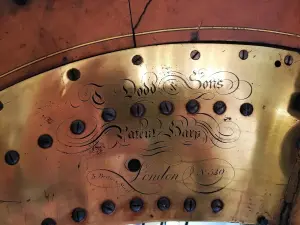
Harp-shaped nameplate from the firm T. Dodd & Sons, Berner's Street, London
Not much is known about the early years of James Dodd, Edward’s middle son—not even his exact date of birth. His workshop was located in the Granby Buildings in Lambeth, a bustling market street in a neighborhood of small blacksmith shops, potteries, and tanneries. Densely populated alleys lined with small workers’ dwellings, or “tenements,” where he and his two sons maintained a substantial production of bow strings. Although he was a highly skilled bow maker, he worked primarily “for the trade.” As a result, his work often went unnoticed because it was sold under the names of the major violin makers for whom he produced. He later moved to other parts of London. Some of his bows were significantly simpler than John’s. He was the first of Edwards’ three sons to die, in 1830.
Thomas’s son Edward had expanded his father’s musical instrument business through his inventions, which improved the playability of harps and pianos. In London alone, there were 150 manufacturers of these instruments. Edward had established a reputation that continued to be successfully leveraged for another 15 years after his death. He was the first of the third generation to pass away, in 1843. His company was taken over and remained active in the manufacture of harps and pianos until after the 1851 World’s Fair. Shortly thereafter, the firm Dodd & Sons disappeared from the scene.
The other branch of the third generation of Dodds consisted of the sons of James I. His first son, James II, was born in 1792, and Edward III in 1797. Between 1821 and 1823, they worked together as bow makers in Covent Garden. They then returned to their father’s workshop to assist him there during the last seven years of his life, until his death in 1830.
After their father’s death, they moved together to Fleet Lane, Old Bailey, which was a notorious neighborhood, close to the Granby’s Buildings where their father had lived. Things hadn’t improved; that place, too, was overcrowded, filthy, and violent. James and Edward worked together making bows and strings, including for their uncle Thomas Dodd. In the mid-1830s, James II turned his back on central London and settled in a small farmhouse on quiet Holloway Road.
That didn't last long; a year later, he had to leave again, and together with James, he settled in the overcrowded working-class neighborhood of Vauxhall, where they shared a workshop for years.
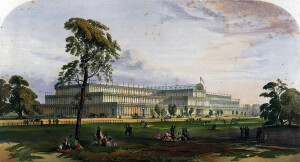
Crystal Palace at the 1851 World's Fair
In late 1850, the brothers decided to participate in the upcoming World’s Fair to be held in London. However, Edward died a month before the opening in 1851. The Crystal Palace was built for this “Great Exposition of Arts and Industry.” There were 13,000 exhibitors from 44 countries. For the first time in England, people could see the state of technology and culture in other European countries and America. The exhibition’s goal was “to make clear to the world its role as an industrial leader,” as Prince Albert put it in his opening speech. Two Dodds participated: Dodd & Sons, with pianofortes and their Patent Double-Action harps, and James Dodd, with four bows.

James Tubbs in his workshop in London in 1917
James had his hands full running the business, which he had to manage on his own after Edward’s death. Experts agree that William Tubbs was responsible for the quality and production of the workshop during that period. Tubbs was a promising young man, technically gifted, and had already made hundreds of bows for them. The stylistic shift toward the more modern English model, which became apparent around 1850, is almost entirely attributed to the influence of William Tubbs. The finest bows in Dodd’s lineup were crafted by Tubbs but sold under the Dodd name. It was therefore William Tubbs who made the bows for the entry.
At the World’s Fair, James Dodd presented a set of four bows (a quartet) finished with gold and tortoiseshell. Tubbs’ name as the maker of the work was not mentioned. When the entry was awarded a medal for craftsmanship and quality, William Tubbs received a large portion of the workshop’s inventory: tools and the wood that Edward and James had worked with. Not far from Dodd’s workshop, Tubbs started his own business.
After the World’s Fair, James moved to North London and settled on Great Sutton Street, a neighborhood with many small printing shops and instrument-making workshops. He worked there for another 14 years and died in 1865. In his final years, he continued to distinguish himself from others with highly unusual shapes for the shank and head.
The French bow makers J.B. Vuillaume, Pierre Simon, and Joseph Henry had also participated in the Great Exhibition. James Dodd had received an honorable mention, but the highest honors, the “Council Medals,” went to the French. Vuillaume even received them for his entire body of work: a quartet of violins and bows. From that point on, French ideas, incorporated into English bows, flooded the market. This was not so much due to James Dodd, but rather to William Tubbs, who sold them under his own name.
The firm Dodd & Sons—which was no longer owned by Edward—was also one of the exhibitors at the Great Exhibition with its pianos and harps. The French were dominant in that category as well. Even the leading English manufacturers, Broadwood and Collard, did not receive an honorable mention. The French firm Erard received two Council Medals, the highest honor, for the pianos and harps they submitted.
Very few experts are able to attribute a Dodd bow to its maker with certainty. They did not keep records of purchases and sales. They often copied each other’s bows or purchased bows from other English makers, and later even imported bows from abroad and stamped them with a “DODD” mark. The stamp they used was another source of confusion. With the exception of James’s, it was the same for every Dodd. The stamps were passed down from father to son, and abroad, the relatively simple stamp was frequently counterfeited.
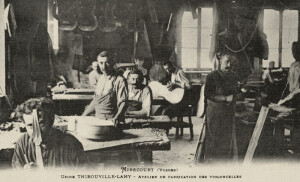
The Thibouville-Lamy factory in Mirecourt, where cellos were manufactured in large numbers—just like (at another location?) Dodd's bows
German copies of Dodd canes appeared on the market, often in huge numbers. Many French companies also produced copies. Jérôme Thibouville-Lamy was the largest. They openly included Dodd sticks in their catalog and exported them in large quantities. Their copies were good, but the best Dodd copies were made by the stickmakers Charles Nicolas Bazin and Eugène Cuniot-Hury. These practices later caused a stir, but they also contributed to Dodd’s worldwide fame. The result was that the authenticity of a Dodd stick was often far from certain.
During the interwar period, new canes were sold under the name Dodd, mostly through a company called Vernon Dodd. Many of the canes sold by the family during this period were, in fact, high-quality replicas, often crafted by German masters such as the Knopf family.
Flaming, J. F., 2016, English, Scottish and Irish Violin Makers, London.
Saint-George H., 2009, The Bow, Its History, Manufacture and Use, 'The Strad' Library, No. III
Westbrook J., 2012, Panormo and His Contemporaries, Cambridge.
Baker T, Dilworth T en Fairfax A., 2001 The British Violin, Londen.
Carlson B., Schmitt J. F., Moroder I., Leonhard F., Italian & French Violin Makers - Vol. 1, 2001, Keulen.
Baldwin M. 2020, Scale of the nineteenth-century London harp industry,
Vannes, R., 1999, *Universal Dictionary of Instrument Makers*, Spa.
Baker T., Dilworth T. en Fairfax A., 2001 The British Violin, Londen.
Basford J. en Toft T., 2020, W.E. Hill, violinmakers 1880-1936, Sheffield.
Milnes and Wilson, 2016, The Hill Bow Makers 1880-1962.
Stagg J.W., 2015, Bowmaking, Bradley.
Plowright D.G., 1934, Dictionary of British bowmakers, Londen.
Heron-Allen, 1902, Violinmaking as it is and was, Londen.
Tarisio, Cozio Archive, accessed in 2026.
British-history; Survey-London/vol46/pp280-293, 2011, Londen.