Instrument

violin
Antonio Stradivari
Cremona,
± 1716
played by
Birthe Blom
Birthe Blom

*1644 , Cremona †1737 , Cremona
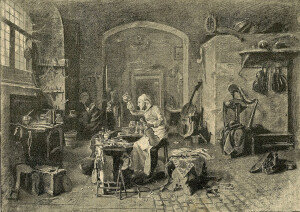
For the first fourteen years, he hadn’t quite found his footing. It wasn’t until he was able to buy a house near the Amati and Guarneri families that he felt he belonged among the greats. That inspired him to build instruments of equal caliber. His family life got off to a turbulent start. He averted a scandal by marrying a woman whose previous husband had been shot dead by her own brother. He had five children with her and six with his second wife.
His fame grew because he had been commissioned to build instruments for the King of England and, on top of that, five for Cosimo III de’ Medici.
Three of his sons worked alongside him, each according to his aptitude and ability. The second-youngest, but most talented, died at the age of 24 before he had even really gotten started. Shortly thereafter, Antonio had a will drawn up. He didn’t think he had much time left, so he bought a grave and had the year in which he expected to die engraved on a headstone. However, Antonio recovered and lived another eight years. During those years, he built a series of magnificent instruments. He even built three more in the very year he died.
After his death, his eldest son and executor had his father buried as he had wished, distributed the estate, and settled into a quiet life. After the deaths of his two other brothers, the youngest Stradivari inherited everything. He kept his father’s instruments for thirty years. After that, he sold everything to a collector.
There was no violin maker greater in his craft than Antonio Stradivari.
It was presumably the plague of 1630 that forced Alessandro Stradivari and Anna Moroni to flee the city of Cremona. Like many residents, they sought refuge in one of the less densely populated villages in the area. Antonio was born there around 1644. There are no archival records to confirm this, but since the Hills reconstructed the story more or less in this way, it has become generally accepted. The name Alessandro is also not entirely certain. He is mentioned as the father in Antonio Stradivari’s marriage certificate, but appears to have died several years before Antonio’s birth.
What is certain, however, is the first mention in the Cremona archives of his presence in the city. It dates from 1665. At that time, Antonio Stradivari was living with Francesco Pescaroli, a master woodcarver and marquetry artist from a noble family. Historians believe he worked for Pescaroli as a woodcarver, and according to the 1667 census, he had the status of “a resident family member,” which meant he was entitled to food and lodging.
Francesco Pescaroli played an important role in the life of the twenty-year-old Antonio. In addition to being a sculptor and woodcarver, he was also a sought-after architect. In that capacity, he had connections among high-ranking officials, the nobility, and the Papal authorities. He traveled throughout northern Italy for his commissions and would then leave his business in the hands of his two associates, Giacomo Bertesi and, most likely, Antonio Stradivari as well. Acting as a representative of Antonio’s parents, he served as a witness at his wedding to Francesca Ferraboschi on July 4, 1667. He offered the couple a house with a shop and workshop in Sant’Agata, the neighborhood where the bride was from. There, in the Casa Naziale, as it was known, Antonio Stradivari lived and worked until 1680.
Nicolò Amati’s workshop was located on Piazza San Domenico, just a few steps away from the house where Antonio Stradivari lived. It was an impressive violin-making business that had been in the family for generations. “Amati” was a household name throughout Europe. Nicolò Amati did the most important work himself, but he had “marqueteurs”—specialists in intricate inlay work—handle the inlay for his famous decorated violins. Baruzzi assumes that Antonio Stradivari, who had gained a wealth of experience in this field while working for Pescaroli, offered to do the inlay work for Nicolò Amati.
While Antonio Stradivari continued to work as a sculptor for Pescaroli and did inlay work, he presumably learned more about violin making from Nicolò Amati in his spare time.
Nicolò Amati was probably his first teacher, but not his only one. Francesco Ruggeri, a former student of Amati’s, was another. Ruggeri had broken away from his great mentor and had started his own workshop just outside the gates of Cremona. There, he built many violins based on Amati’s “Great Model,” but did so in a slightly different way than Amati. Stradivari used this construction method in his first violins. This technique was found in Ruggeri’s work but not in Amati’s.
Until then, Antonio had not been able to make a living from his violins; the competition in Cremona was simply too fierce. Antonio may have received a few commissions that other violin makers turned down, but he still played only a marginal role in Cremona. Until Francesco Pescaroli’s death in 1679, Antonio continued to work for him, carving scrolls and ornaments and performing intricate inlay work on the commissions that Francesco Pescaroli was by then receiving from all over northern Italy.
The earliest known violin by Antonio Stradivari dates from 1666. On it, he writes that he was a student of Amati (Alumnus Nicolii Amati). However, the violin bearing this label bears no resemblance whatsoever to an Amati, but rather resembles a Ruggeri. Nicolò Amati held supreme power in the hierarchically organized city of Cremona and presumably did not allow others to compete with his successful violin and cello models.
Stradivari’s family life got off to a turbulent start. He knew Francesca Ferrabosci as the wife of Giovanni Giacomo Capra, a close friend of his employer, Francesco Pescaroli. For reasons that remain unclear, Francesca’s brother shot and killed her husband, Giovanni, in 1665. The perpetrator fled and went into hiding. Francesca was four months pregnant at the time. It is believed that Antonio was the father. The law stipulated that she could only care for her child if someone stood surety for her. During the trial that took place in 1665—which also had to rule on the return of her fugitive brother—Antonio Stradivari proposed to resolve the disputes and to marry Francesca. Her two children from her marriage to Capra were placed in the care of her father-in-law. Francesca was allowed to raise her third child in Antonio Stradivari’s home.
The fact that Stradivari had already gained the protection of high-ranking circles is evident from the fact that a senator from Milan and two prominent families in Cremona were willing to vouch for this arrangement. Francesco Pescaroli gave Antonio Stradivari a house with a shop in the Sant’Agata neighborhood, which would allow him to provide for his pregnant wife, Francesca. But after the birth of Francesca’s daughter, the formalities took nearly two more years before Antonio Stradivari and Francesca Ferraboschi could marry in 1667. Their daughter was born as early as December 1665, followed by five more children: in 1670, Francesco in 1671, 1674, and 1677. Finally, his son Omobono was born in 1679. Only the three sons went on to work with Antonio.
Stradivari did not build many instruments in the fourteen years following his first violin. Only sixteen of his instruments are known to have been made between 1666 and 1680—not enough to support his family. Cremona had lost much of its vitality due to the plague and the economic downturn. The population had fallen from 40,000 to 10,000. Moreover, the German and French regions where violins were built had become much more successful than Cremona. Most musicians had left for Venice, Ferrara, Mantua, or Brescia, where a much more vibrant cultural scene prevailed. Only a few violin makers remained in Cremona who, like Guarneri, Ruggeri, and Amati, were able to make a living from their craft. Until 1679, Antonio Stradivari was forced to supplement his income as a violin maker by working for Francesco Pescaroli.
In 1679, Antonio Stradivari built a richly decorated violin, a statement in which he combined his craftsmanship as a marquetry artist with that of a violin maker. The model was more robust and striking than his previous ones. Sir Samuel Hellier, a music connoisseur and collector of stringed instruments, frequently traveled to Italy in search of additions to his collection. Hellier purchased two violins by Stradivari and made this known to others. This gave his career a significant boost. He also purchased the 1679 violin, but not until much later. Father Arisi, who knew Stradivari well, wrote: “...he (Stradivari) is unrivaled in the crafting of ornamented instruments; they are often adorned with small figures, flowers, arabesques, and ornaments, gracefully inlaid with ivory and ebony—a true tribute to the patron.” The “Hellier” was one of them.
Throughout Europe, musical styles gradually changed. Composers wrote music in which violins and cellos began to play a more prominent role. Alongside existing church music, secular music was rapidly gaining popularity, often featuring complex parts. The new technical demands this entailed called for a different type of instrument. Antonio Stradivari’s violins and cellos were better suited to this than those of other makers. By 1680, Stradivari had earned a fine reputation not only among musicians but also among wealthy collectors.
The Italian composer and virtuoso violinist Arcangelo Corelli was immensely popular at the time. His music was even performed frequently in London. King James II had instruments sought out to do justice to Corelli’s music. Stradivari received the royal request to supply him with several instruments. After that, the number of commissions increased. In 1690, Marquis Bartolomeo Ariberti had a letter delivered to Stradivari in which he commissioned him—providing a whole series of details—to build two violins and a cello. They turned out to be intended not for himself but for Cosimo III de’ Medici, who was then Grand Duke of Tuscany. The music-loving ruler was impressed and immediately ordered two violas to complete the quintet. These commissions undoubtedly contributed to the widespread recognition of Stradivari’s craftsmanship.
Shortly after Pescaroli’s death in 1679, his heirs claimed the Casa Naziale. After renting the house for thirteen years, Antonio Stradivari and his family were forced to leave. In 1680, he purchased his own house on Piazza San Domenico, practically next door to Amati and Guarneri. It was larger, had one more floor, and—not insignificantly—had its own well in the spacious courtyard. Of the purchase price, which amounted to 7,000 lire, he paid 2,000 lire as a down payment. He was allowed to pay the remaining amount in installments. Antonio had seen from Nicolò Amati how a large business should be run, and Pescaroli had taught him how to deal with the wealthy. Four years later, he had already paid off his house.
Antonio spent many happy years with Francesca. His fame spread far and wide across Europe, and his income grew accordingly. Now that he was an established luthier and his daughter Giulia could bring a substantial dowry, he began searching for a life partner for her—preferably one who could help strengthen the business. That person turned out to be Giovanni Farina, a notary from Cremona who would later draw up nearly all of Stradivari’s legal documents. After the wedding in 1688, he often acted as the family’s legal representative.
In 1698, Francesca fell ill. A young woman was hired to care for her, but Francesca died in May of that year. Antonio spared no expense or effort for what Hill called “the most talked-about funeral of his time.” Bells rang throughout the city for an hour, and 67 priests from three different parishes were present to conduct the funeral service. Antonio certainly cannot be accused of failing to display his wealth. He organized her funeral to be grander and more impressive than that of Guarneri, who had died shortly before, or that of Ruggeri, which took place a few months later.
A few months after Francesca’s death, he found a new life partner. She was Antonia Zambelli Costa, the daughter of a local merchant who, given the modest dowry he was able to provide, was not particularly wealthy. She was, however, twenty years younger than Antonio. The formalities surrounding Francesca’s death took months to settle, so Antonia was not able to move in with Stradivari until late 1700. With her, he would have five more children between 1701 and 1708: three sons and two daughters. Their first son, Giovanni Battista Giuseppe, died shortly after his birth; the second, Giovanni Battista Martino, born two years later, would prove to be talented; Giuseppe Antonio, born in 1704, became a priest; and the fourth, Paolo, became a cloth merchant. Their two daughters, Francesca Maria and Catherina, remained unmarried. These five children were all younger than Stradivari’s grandchildren, who were born in the 1690s to his daughter Giulia Stradivari and her husband Giovanni Farina.
In Cremona, following the emergence of competition from both within and outside Italy, only a few violin makers remained. The rest had either given up or left. Only Nicolò Amati still played a significant role. He had reached a level of craftsmanship that was virtually unmatched in his time. But Nicolò Amati was already advanced in age and continued to stick to his familiar models. Wealthy clients who had previously commissioned their instruments from him began to turn to Antonio Stradivari instead. Around 1680, this led to the Amati family’s first financial difficulties. Nicolò died in 1684. His son continued the business but fell far short of his father’s achievements. This cleared the way for Antonio Stradivari to take over Amati’s position.
His three sons—Francesco, the eldest, whom Antonio himself called his most devoted son, and Giovanni Battista Martino—were trained by Antonio himself. They initially did the preparatory, rough work, after which Antonio finished the instruments. It was not until around 1700 that he gradually allowed his two sons to build instruments entirely on their own. Not yet under their own names, but under Antonio’s.
The third son, Omobono, also worked for Antonio. Presumably not yet as a violin maker, but he did his part in the ever-expanding organization of his father’s business. In 1696, Omobono set out on a journey through southern Italy that lasted several years—a journey funded by Antonio. Dilworth believes that it was not merely a journey by a son seeking to break away from his father, but that he viewed it primarily as a “Grande Tour”—an educational journey intended by both father and son as an investment in the future. With the knowledge and experience gained during his journey, he would be better prepared to assist his father in the important role that Antonio Stradivari had set out for himself. Things turned out differently. Omobono arrived in Naples around 1697 and, much to Antonio’s dismay, lingered there for quite some time.
It was not until two and a half years later that Omobono returned to Cremona, too late for his mother’s funeral. She had died a few months before his return. The strained relationship between Omobono and his father seemed to have been somewhat mended a few years later. Omobono became active and confidently assumed an important social role in Cremona. He joined the board of at least five charitable organizations and was elected president of a sixth, that of the Santa Barbara parish. Omobono remained involved in the business side of his father’s company. Although Antonio did not seem particularly proud of him at first, over time Omobono came to be regarded as an important figure in Cremona. His signature appears as a witness on a large number of documents. He also regularly acted as a mediator in various conflicts within the city.
The courtyard on Piazza San Domenico had certainly been bustling with activity since at least 1690. Stradivari and his sons were building their instruments at a rapid pace, and that included all sorts of accessories. Bows had to be planed, strings wound, and tuning pegs and endpieces made. There were no suppliers for these items yet. Violin cases were also made right there in the workshop. In Cremona, it was customary to have local boys do this work. On the rooftop terrace, violins hung in the sun to develop their brown patina, and the freshly varnished instruments were also hung there to dry. As Stradivari became more successful, activity in and around the workshop increased, but he refused under any circumstances to have assistants help him with violin making. Only Francesco and Omobono were allowed to do so, and even then, mainly to handle the preparatory work.
That presumably changed around 1700. By then, Antonio had trained two of his sons. Francesco, his most devoted son from his first marriage. Omobono, born in 1679, also worked for him, though presumably not yet as a violin maker. The Hills speculate that he handled purchasing and managed the increasingly complex affairs of his father’s business. For example, he traveled on his father’s behalf to Castell’Arquato in Piacenza in 1728 and to Modena in 1731. Notarial deeds show that, when necessary, he also collected overdue payments on his father’s behalf.
Antonio likely began training his son, Giovanni Battista Marino, around the time he was twelve. John Dilworth believes that in 1716, the nearly 14-year-old Giovanni built a violin that was no longer a beginner’s instrument, but rather an iconic violin that would later be called the “Messiah.” Giovanni Battista Marino, in Dilworth’s opinion, was active in the workshop between 1714 and 1727 and may therefore very well have been involved in the construction of some of Stradivari’s greatest instruments.
Both Omobono and Francesco sometimes built instruments for themselves. However, their father’s influence was so strong that the individual styles of all three of his sons were virtually invisible before about 1720. After that, only a handful of instruments by Francesco appeared bearing the inscription “sotto la disciplina Antonio Stradivari.” Almost all of those labels were later removed so that the instruments could be attributed to Antonio. This made them worth a great deal more. There is one instrument by Francesco that escaped these practices and is even regarded in many respects as a worthy Stradivari instrument. This is the “Salabue,” named after Count Cozio di Salabue, who purchased it in 1775.
Omobono made more of them under his own name. About fifteen of his instruments are known; most date from 1724 and later. Three of them bear Omobono’s label: “Omobonus Stradivarius Filius Antonij / Cremone Fecit Anno 1740.” The other twelve instruments were unbalanced and made of inferior wood—not the sort of instruments that would have met Antonio Stradivari’s approval.
By 1727, nine of Antonio’s ten children had remained healthy, a rarity at that time. At the end of that year, however, Antonio’s promising son, Giovanni Battista Marino, fell ill and died shortly thereafter. Antonio cherished his “Messiah.” He kept the violin in the condition in which Giovanni had built it until his own death.
In 1729, Antonio felt his strength waning. As a prelude to his own funeral, he had three different versions of a will drawn up one after another. He even bought a grave and was so convinced that he would die soon that he had the year 1729 carved into a headstone in advance. He drafted the will himself. He had not become any more lenient in the final years of his life. He named Francesco—whom he called an obedient and docile son—as his successor. Francesco received the workshop, the inventory, the stock of instruments, and everything from the rooms where Antonio “now sleeps and resides.”
Thirty years later, Omobono’s ill-fated journey still seemed to be weighing on Antonio’s mind. From the first draft of the will, it appears that the journey had not met his father’s expectations at all. Antonio deducted all the expenses he had incurred for Omobono’s trip from his inheritance, and he phrased that section of his will in less-than-flattering terms. In the second version, written a few months after the first, Omobono was still allowed to select some tools from the workshop, but between the second and final versions of the will, the relationship between father and son had apparently not improved, for Antonio even deprived him of the right to the tools. He was, however, allowed to choose a few household items.
For all his other children, Antonio Stradivari set aside a modest annual allowance. He wrote his will in firm, patriarchal terms that did not quite match the frailty he thought he was feeling. However, Antonio did not die that year; instead, he recovered. The instruments he built afterward are powerful and are not much inferior to those from his heyday. He was proud of them: he wrote by hand on the label: “made in the 90s of my life; “d’anni 90.”
His other descendants received the bulk of the inheritance in the form of violins. He had set a specific amount for each instrument—on average, about 1,000 euros when converted to today’s standards. He had already paid by far the largest share of the inheritance to his youngest son, Paolo, before his death. With 120,000 euros—also converted to today’s standards—he bought him into the business as a co-owner of a Cremona cloth merchant. The annual allowance for the others amounted to approximately 2,000 euros per year.
Antonio Stradivari did not die in 1729, but eight years later, in December 1737. In January of that year, he had still signed the deed transferring the dowry that his future daughter-in-law, Elena Templari, brought upon her marriage to his son Paolo, and in that same year, he personally crafted three more violins. Shortly after Paolo’s wedding, Antonia, his second wife, died. Antonio had her interred in the tomb he had purchased in 1729. The ceremony was not as impressive as Francesca’s had been. Antonio was already 93, ill, and died in December of that year.
He had left the entire estate to Francesco and appointed him as executor. Francesco had the Mass at his father’s funeral conducted exactly as Antonio had wished and had him laid to rest in the tomb of the small chapel where Antonio’s second wife was also buried, in a corner of the San Domenico Church, directly across from their home. In the absence of a birth certificate, the church archivist noted that Antonio Stradivari, a widower, had died at the age of approximately 95. Francesco also meticulously carried out his father’s other last wishes; he had six more Masses said in his memory and ensured that his two sisters and his two surviving brothers received their shares of the inheritance. For his part, he decided to take it easy. Francesco was no longer his father’s assistant but the owner of a thriving business. That period of prosperity did not last long, however. He built only a few violins after his father’s death. Francesco had become a wealthy man, but he lacked his father’s ambition.
Omobono died in 1742 and Francesco a year later; Paolo, Antonio’s youngest son, inherited everything. However, most of the nearly one hundred instruments left behind in the Stradivari workshop were no longer playable. Paolo offered Carlo Bergonzi—who had helped Antonio build several instruments—their old house and workshop, but on the condition that Carlo finish building all of his father’s instruments. Paolo himself left Cremona.
After Bergonzi had completed the work, Paolo left the instruments untouched for another thirty years or so. They represented a small fortune, but Paolo made no effort to sell them. It was not until 1775 that interest in the instruments finally emerged. It came from the great collector and connoisseur of Italian violin making, Count Cozio di Salabue. Cozio had set his sights on Antonio Stradivari’s instruments and made his first attempt that year to purchase the entire collection from Paolo in one go. The negotiations took several months, after which all the instruments ultimately went to the collector. The “Messiah,” the violin that Giovanni had built, was also among them—unplayed and undamaged. Di Salabue knew full well what a treasure he had acquired. For a year, he pestered Paolo with requests to sell him the drawings and tools as well. In 1776, he finally obtained them as well. In his final letter to di Salabue, Paolo writes: “It is my wish to inform you that I will be at your service so that nothing of my father’s remains behind in Cremona”. A rather unflattering remark from a son who owed his immense wealth to his father.
The earliest known violin by Antonio Stradivari dates from 1666. He was 22 years old when he built it. In those days, that was an age at which someone had long since begun a career. In Goodkind’s opinion, however, Stradivari had not yet found his stride until 1680. In those fourteen years, he built no more than 19 violins, cellos, and violas of highly variable quality. The “Hellier” from 1679—the year Omobono was born—was exquisite, but many others were still far from the level he would later achieve. Presumably, he built more guitars, lutes, mandolas, viols, viola d’amores, and harps during that time. His instruments from that period still feature Amati-style edge inlays, contours, and curvature, though Antonio’s scrolls are rounder and more powerful than Amati’s. He had already developed a beautiful varnish that beautifully highlights the wood’s grain.
That changed after he moved to Piazza San Domenico in 1680. He redesigned his workshop, had more space at his disposal, and built his first cello. But that wasn’t all. He had risen in social standing and was just a few steps away from the great violin makers Amati and Guarneri, who had dominated violin making for generations. He was one of them! The Paganini violin dates from that year. While all his earlier instruments had been loosely based on the Amati model, in 1683 he broke away from that tradition. They became sturdier, more robust, and had a different contour. He suddenly produced 13 of them, and in the years that followed, that number continued to rise. They all possess a confident splendor befitting someone who had by then mastered his craft to perfection.
That was, in fact, the point at which he dared to experiment further. All the lines of the edge inlay and the f-holes from that period are carved with rare precision. The need for an instrument with a rich tone arose from a new generation of composers and violinists who were writing music in which the violin was set to play a prominent role. But that was not all; they clearly had different demands for a violin than when it was still used to accompany singing and dancing. Arcangelo Corelli articulated this change. He taught his students that “the ability to touch the heart was the touchstone by which a true and great violinist is recognized.” Stradivari had to begin building instruments that made possible the combination of virtuosity and sensitive playing.
He made two significant changes: his violin was 12 mm longer than the traditional model, and he reduced the curvature of the top. To prevent the top from becoming less flexible, he adjusted the thickness of the wood, resulting in a deeper, richer tone. This development coincided with that of Maggini and Gasparo da Salò from Brescia, who were already known for their instruments with a powerful, dark tone. During this period, Stradivari also chose beautifully figured wood, which he finished with a new type of varnish: an intense red with a golden base.
Between 1689 and 1703, Stradivari experimented extensively. There are 22 known templates that he used as the basis for building his instruments. Of those 22, 16 have been thoroughly examined by Nicolas Sackman. The templates were not only for violins, cellos, and violas, but also for violas da gamba, violas d’amore, contralto violas, and tenor violas. He marked nearly all of them with a letter, and on most of them he also inscribed the date on which he first used them. This shows that he did not begin the series until 1689 and made the last one in 1709.
It seems that after that, he was satisfied with what he had developed and with the stringed instruments he built—primarily based on the templates from that period—during the twenty-eight years he lived afterward. That might explain why his output increased; he no longer had to come up with much that was new. He did introduce long corners, which made his work more elegant, but these were no longer substantial changes. From that year on, he was able to focus on the high demand for his instruments. In 1703, he built 18 instruments, and in 1709, as many as 24. That marked the beginning of his golden age, which lasted until 1722. Antonio Stradivari was 78 years old at the time.
After that, the precision of his work gradually declined; he left tool marks visible and used materials of slightly lower quality. It was not until his final years that the steadiness of his hand began to wane, but that did not detract from the sound; it remained superb.
Stradivari built about 1,100 stringed instruments, of which approximately 600 have survived. He set the standard by which stringed instruments were—and still are—judged for centuries.
Goodkind, H. K., 1972, Iconography of Antonio Stradivari, 1644-1737: Treatises on the Life and Work of the Patriarch of the Violinmakers. New York.
Hill, William Henry, Arthur Frederick Hill, and Alfred Ebsworth Hill., 1902, Antonio Stradivari: His Life and Work, 1644-1737, New York.
Sacconi, S. F., 1979, *The Secrets of Stradivari*: Cremona; Vannes, R., Lebet, C., 1981, *Universal Dictionary of Violin Makers*.
Powers, W., 2000, “Violin Makers: Nicolò Amati (1596–1684) and Antonio Stradivari (1644–1737).” In Heilbrunn Timeline of Art History. New York.
Hamma, W., 1964, Masters of Italian Violin Making. Rev. ed. New York.
Henley, W., 1997, Universal Dictionary of Violin and Bow Makers. 1956-60. England.
Pollens S., 2010, Stradivari, Cambridge.
Hargrave R., 2009, The Amati Method, Three articles about the Amati family.
"From the Archive: a violin by Nicolò Amati, Cremona, 1660-70”, The Strad, 2018.
Kass P. J. The Stati D'Anime of S. Faustino in Cremona: Tracing the Amati Family 1641-1686.
Santoro E, 1981, Antonio Stradivari, Cremona.
Marubbi, M., and Giacomo Bertesi, 2010, in Proceedings of the Soresina Conference, Cremona.
Cremona Archives, visited in 2021.
Tarisio; the Cozio archives, John Dilworth, Stradivari and his sons, bezocht in 2021.