Instrument

violin bow
André (fils) Vigneron
Paris
played by
Marta Madara Papane
Marta Madara Papane

*1881 , Mirecourt †1924 , Parijs
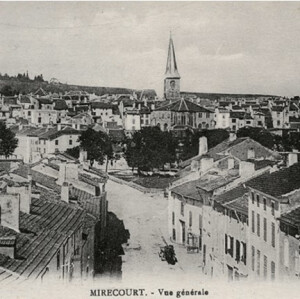
Around the time of André’s birth, Mirecourt was already the premier center from which most French violin makers and bow makers hailed or where they received their training. Among the bow makers, Charles Nicolas Bazin was by far the most important figure in Mirecourt. His workshop was a breeding ground where great bow makers such as Jules and Victor Fétique, Émile Auguste Ouchard, Louis Piernot, and Claude Auguste Thomassin learned their craft. They typically made their bows based on the Voirin model.
André’s father came from a different background. He had been trained by his father-in-law, a lesser-known but no less accomplished craftsman among cane makers: Charles Claude Husson. This cane maker was deeply inspired by the Peccatte family, whose work was robust and unadorned.
Only highly skilled craftsmen with an entrepreneurial spirit survived the competition from the large manufacturers in Mirecourt, who produced thousands of instruments and bows each year. In 1880, after the Union went bankrupt, André’s father did not go to work for Thibouville-Lamy, as many of his former cooperative colleagues did, but instead went to Paris.

Joseph Vigneron
The move to Paris took place in 1881. Joseph was able to begin working in the workshop of Eugène Gand and Gustave Bernardel, two instrument makers who, together, would soon go on to lead one of the most important firms in Paris. They owed their reputation not only to the high-quality instruments and bows made in their workshop, but certainly also to the large number of outstanding violin and bow makers who worked there and received their training there. These artisans often began their careers in the workshop and later supplied their bows to the firm, often without being formally employed. All the bows sold by the firm bore the “Gand et Bernardel Frères” brand mark, regardless of who had made the bow.
Two years after Joseph Vigneron joined the company, it was commissioned by the French government to build all the instruments, including the accompanying bows, for the orchestra of the Palais de Trocadéro. Joseph Vigneron continued to work for this firm for seven years before striking out on his own. As an independent entrepreneur, he was able to put into practice what he had learned at Gand et Bernardel—and pass it on to André.
In 1888, André’s father opened a shop at 54 Rue de Cléry in Paris, right in the heart of the city. He trained André in their own workshop, and André became his sole employee in the early years. Over the years, the partnership between father and son grew ever closer. By the last few years before the turn of the century, their collaboration had reached such a level that there was hardly any difference between the bows made by Joseph and André. André’s father was known for the speed with which he could make a bow. Joseph Vigneron made six bows in a six-day workweek.
The partnership changed somewhat when André and his father had a disagreement about the future of their work. The canes that Joseph Vigneron made in his later years lacked a certain refinement. He had no interest in more decorative materials such as tortoiseshell and ivory; functionality was always his top priority. While his father wanted to continue making simple canes, André wanted to adopt a more refined approach and cater more to the tastes of the time. Despite their differences of opinion, father and son continued to brand their canes with the same mark: Vigneron à Paris. In addition to André, Marie Louis Piernot joined them from 1900 to 1905. Piernot was an outstanding cane maker, trained by Charles Nicolas Bazin.

Example of a "Parisian eye"
André got married in 1903 and became the guardian of a daughter. His father died just two years later, in 1905, not far from Paris. Louis Piernot left, and André Vigneron moved his firm to 70 Rue de Rome, the “Mecca” of Parisian violin makers. During this period, he altered the shape of the scroll and added a “Parisian eye” to the scroll, a silver or gold ring surrounding the mother-of-pearl center. He continued to use his father’s stamp until 1910, after which he had a new one made: André Vigneron à Paris, and began numbering his finest instruments.
Nothing is known about him during the period between 1914 and 1920. He was likely drafted as a soldier and was wounded in the trench warfare of World War I.
It wasn’t until around 1920 that André Vigneron resumed his work. A year later, he hired Mars Auguste Husson. This bow maker had learned the trade from Charles Nicolas Bazin but had also crafted fine bows for Thibouville-Lamy. As a result, he was skilled in both fine craftsmanship and mass production. Later, Louis Piernot rejoined André Vigneron’s workshop. Together with them, he crafted a large number of excellent bows in a short period of time.
André Vigneron's work was highly regarded by musicians immediately after 1920, and he was able to afford expensive materials
André Vigneron had a catalog in which he showcased his bows to musicians, but he also made them for others, such as L. Bernardel, E. Marchand, and E. Courviser. Together with the virtuoso violinist and professor at the Paris Conservatory, Lucien Capet, André Vigneron developed a bow that was slightly longer than usual, and he would go on to make more of them between 1912 and 1915. The model was listed in his catalog under the client’s name: modèle Capet.
It was the second attempt to make a cane with Capet. His father had previously developed a cane with him—one with an almost triangular cross-section and a pronounced curve—but that had not been a success. Louis Piernot had adopted the design, but he, too, failed to make the stick popular. This second stick sold better, but he didn’t make much of a profit from it. However, the design caught on with double bass players, and this shape is still sometimes used for that instrument today.

Detail of an A. Vigneron bow with a tortoiseshell ferrule. Photo courtesy of Benning Violins.
André Vigneron’s work was highly regarded by musicians immediately after 1920, and he was able to afford expensive materials. In his later years, for example, he also made sticks with gold mounts and tortoiseshell sleeves.
After his return in 1920, he lived for only four more years. André Vigneron died in Paris in 1924 at the age of 43.
“Whenever we pick up a Vigneron bow, an involuntary exclamation of pleasure rises to our lips,” wrote William Henley, somewhat melodramatically. He believed that Vigneron, father and son, belonged to a small group of French bow makers who possessed the rare talent of making each of their bows exceptionally playable.
André Vigneron’s sticks are usually round and made of reddish-brown to dark-brown pernambuco wood. Until his father’s death, his design was based on what his father had already developed at Gand & Bernardel. The period that followed was one in which the influence of the Parisian school of Vuillaume can once again be seen in his work. Beginning around 1912, he refined his craft. The heads became smaller, the shafts slightly rounder, and the end knobs changed in proportion to these changes.
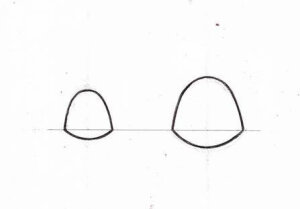
Vigneron D-model. Cross-section at the head (left) and the wrap (right). Image courtesy of Hamilton Caswell, Bowspeed
André used three stamps: one belonging to his father, “André Vigneron à Paris”, and “Vigneron Paris.” Even in the brief period after 1920, he occasionally returned to using his father’s first stamp. Vigneron’s influence on later bow makers was significant. There is still a demand for double bass bows based on the Vigneron “D-model” (see illustration).
Millant, B., Raffin, J.F., 2000, *L'Archet: French Bowmakers, 1750–1950*. Paris
Vatelot, E., 1976, *Les Archets Français*, Nancy
Milliot, S. and Perrin, N. 2017, European Stringed Instrument Making Day. Paris
Thöne J, 2008, Italian & French Violin Makers, Dubai
Carlson B., Schmitt J. F., Moroder I., Leonhard F., 2007, Italian & French Violin Makers, Keulen
Vannes, R., 1999, *Universal Dictionary of Instrument Makers*, Spa
Henley W., 1959 Universal Dictionary of Violin and Bow Makers. Amati Publications. London
Jacquot, A., 1912, La Lutherie Lorraine et Française, Paris
Tarisio; the Cozio archives, accessed in 2025
Archives Nationales de France, accessed in 2025