Instrument

violin
Aegidius Klotz (Kloz)
Mittenwald
played by
Simone Ariane Alder-Gendron
Simone Ariane Alder-Gendron

*1733 , Mittenwald †1805 , Mittenwald
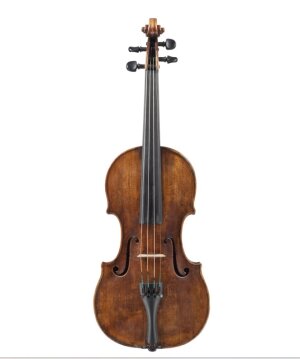
When Aegidius was born, the family was already known for their fine instruments, and his father was a wealthy man. He had inherited several plots of land and a few houses, and through his marriage, the couple had come into possession of a portion of a building on Stainergasse.
That was where Sebastian Klotz had started his workshop and where their first child, Georg Carl, was born. Six years later, the house had become too small, so they moved to Hochstraße, also in Mittenwald. That was where Aegidius was born. Father and son would continue to work on Hochstraße for the rest of their lives. The workshop employed a large number of workers and apprentices, just as had been the case with Mathias.
At the time of his birth, Aegidius already had a brother ten years his senior, Georg Carl. He, too, would become a violin maker. Undoubtedly, as boys in Sebastian’s workshop, Aegidius and Georg gained a good understanding of how the work was done, but they received their actual training from another luthier. This was part of a work-study program in Mittenwald that an apprentice had to complete to become a master violin maker. Georg Carl subsequently established himself as an independent luthier, but Aegidius returned to Sebastian’s workshop. There he continued to work alongside his father until the latter’s death in 1775. Many researchers have attributed the violin that Leopold Mozart bought for Amadeus to Aegidius Klotz—a violin that Amadeus later played himself and used when composing his violin concertos.
Many researchers have attributed the violin that Leopold Mozart bought for Amadeus to Aegidius Klotz
Aegidius’s father’s body of work featured a variety of models, ranging from Nicolò Amati to Stainer. This was likely the result of a certain degree of freedom that he allowed himself and his assistant. Later, Sebastian’s own model would come to be regarded as “The” Klotz violin. Under Sebastian’s guidance, Aegidius developed into an outstanding craftsman. Beginning in 1775, the year his father died, his workshop grew into a business that produced such large numbers of high-quality instruments that the Italian centers viewed it as a threat.
While Sebastian had already built many different models, Aegidius expanded on that even further. In general, they are his own versions of Amati shapes, such as those used by Stainer—who was better known at the time. Due to their full, strongly arched shape, the sound was light and “silvery,” which suited the tastes of the era well. Aegidius’s instruments are flatter than Sebastian’s model, but still taller than those of Antonio Stradivari.
Given the size of his workshop, his output must have been impressive. It is impossible to determine the exact figure. Stainer labels were later affixed to many of his instruments, and they were meticulously replicated by lesser craftsmen.
His instruments are well-proportioned and symmetrical. The upper corners are set high and angled outward. The interior of the violin is meticulously finished, with structural components made of pine. The three strips of the edge inlay are wide and made of maple; the middle one is painted black. The f-holes differ from most others in the Klotz family. They are strikingly prominent on the top, stand upright, are cut wide, have an oval end, and feature “wings” that fan outwards.
The curl that Aegidius usually used also became his trademark. Connoisseurs use this, among other things, to distinguish his instruments from those of his father. All members of the Klotz family had one or more personal identifying marks. Aegidius’ signature was a notch at the end of the tuning peg box, in the center of the bevel.
Aegidius used several types of varnish, which he applied in thin layers to a fairly dark background: ranging from a deep ochre brown that was not entirely transparent to a nearly transparent ochre yellow.
Aegidius Klotz’s instruments were frequently copied until the end of the nineteenth century, often bearing the names of others, but his instruments were also replicated because of their fine tone and sold as Stainer violins. Klotz instruments were found not only in Germany but also in most other European countries.
The label: “Aegidius Kloz in Mitten-/vvald an der Iser 17..,” printed within a decorative border (see image below).
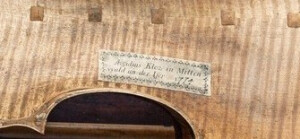
Bron: violin-world.com
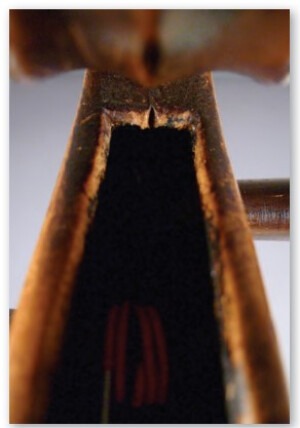
Notch in the tuning peg box. Photo courtesy of the Mittenwald Violin Museum.
Strad 2018/09, In focus a 1791 Aegidius Klotz.
Archives of the Mittenwald Museum of Violin Making
Vannes, R., 1999, Universal Dictionary of Instrument Makers, Sp
The Smithsonian Institution, The Klotz family
Tarisio, Cozio Archive, accessed in 2024