
Ukraine Campaign:
We’re
keeping at it!
We hear both heartbreaking and heartwarming stories through our interactions with refugee musicians and donors of instruments. Our effort to help refugee musicians obtain instruments—so they can at least continue playing—is progressing steadily, though not without challenges. And we are committed to acting with the utmost care out of respect for the generosity of our donors. Here’s where we stand at the moment:
Falling Behind
Imagine this happening to you: your quiet life as a teacher at a music school in eastern Ukraine is suddenly turned upside down by the ruthless aggression of the leader of a country that, until recently, was considered a brother nation. As a result, at the age of 62, you have to gather your belongings and literally flee for your life, together with your youngest daughter. In a distant land where they speak an incomprehensible language (and sometimes a bit of English, but not always the same English you learned at home…), you see daily images of what was once your city, now a gray ruin. An arrow marks where your home and your school once stood. Your other daughter stayed behind and is helping supply the local militia; your son-in-law is suddenly a fighter on the front lines there. Your piano, your accordion, and all your other instruments were left behind, and it’s doubtful you’ll ever find them again.
Life Stories
We hear these and similar heartbreaking stories in our interactions with musicians from Ukraine. And it is precisely for these people—for whom music is a lifeline—that we are organizing this campaign. The stories of our donors are of a different nature—but equally impressive: extraordinary life stories centered on the role of music and playing a cherished instrument. “How proud my grandfather would have been if he’d heard that his cello is getting a second life.” “I hope the next person to play it will be just as happy with it as I was.” Those stories and the generosity with which these special instruments are donated are truly heartwarming.
Priorities
Our initiative is now making steady progress, though not without its challenges. We began in March by collecting musical instruments to provide to Ukrainian refugees. However, the registration of refugees is handled on a decentralized basis, and determining whether there is a need for a musical instrument is not the first consideration. A roof over one’s head, food, access to medical care, education for the children, and the chance to calmly get oriented in one’s new surroundings—to find peace and a sense of normalcy after a chaotic flight—these are the top priorities. When someone does not yet have a stable place to stay, an instrument cannot be safely stored or played without disturbing others. We are obligated by the generosity of our donors to proceed with the utmost care.
Matches
Thanks to our networks of musicians and conservatories—and sometimes even through serendipitous encounters—we’ve already made a number of great matches:
Maria (11) has a bandura on loan from a woman in Zwolle.
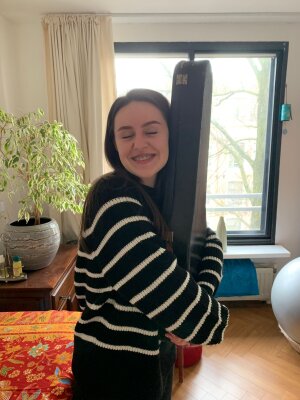
A Ukrainian musician has received a violin. She hopes to begin her violin studies in September.
An oboist, who is staying with her daughter in a host family, now has an oboe to play again. She couldn’t bring her instrument with her because it belonged to a theater in Ukraine. Her daughter was, however, able to bring her flute.
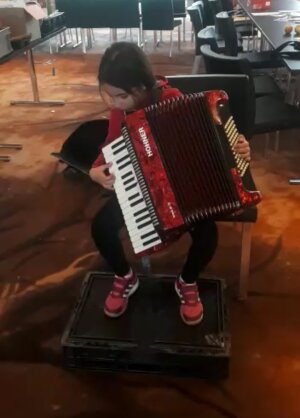
Angelika (7) is staying with her parents at a hotel in Lijnden. She wanted nothing more than an accordion. She now has an accordion that’s the right size and has new straps.
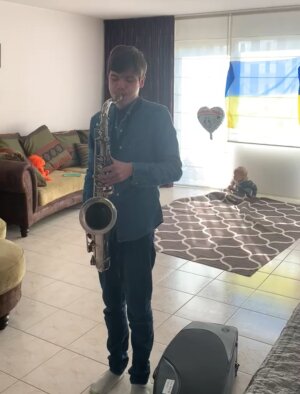
Yuri (18) has autism, and playing his saxophone provided him with a great source of stability in Ukraine. Thanks to the Harmonie Amicitia Music Association in IJsselstein, we were able to provide Yuri with a saxophone.
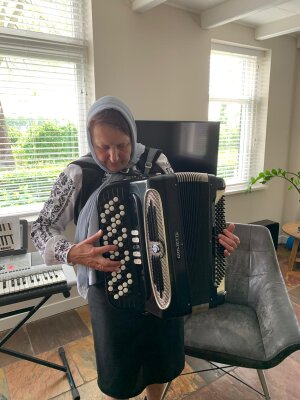
Luba (63) is a teacher at a music school in the Donbas region. She is now staying with her daughter near ’s-Hertogenbosch. Luba is overjoyed with the gift of a beautiful Italian accordion, which she immediately began playing. Her daughter noticed that her mother suddenly seemed “back to her old self” again and predicted, “It won’t be quiet around here very often anymore…”
Call for Participation
What’s next? So far, the Musical Instrument Fund has focused primarily on the donors of the instruments—with great success and gratitude. We have now received donations of about 200 instruments. In the coming period, we will establish even more contacts to facilitate matches. The project is now explicitly aimed at Ukrainian musicians and music students, but this in no way excludes other refugee musicians. Although the project’s founders have made a name for themselves in classical music, the project remains completely open to musicians from other styles and genres, such as jazz, folk, world, and pop music. Finally, we are in discussions with organizations to place instruments that cannot be distributed to their intended recipients with partners who know how to make good use of them.
We urge you to contact us if you know any refugee musicians who could use an instrument. Please call or email Ben Cartens, project manager.
Donate
You can also make a financial contribution to this project by the Musical Instrument Fund. To do so, visit this page. Thank you!
Do you have an instrument you’d like to make available to musicians? Please let us know by clicking the button below. We’ll get in touch with you as soon as possible.
Want more information?
You can read more about this emergency relief campaign by the Musical Instrument Fund on this page. There you can find out how to help us provide instruments for refugees or make a monetary donation. Thank you very much!
This campaign is supported by: