Talent

Gwyneth Wentink
plays a
harp
from Salvi
from Salvi
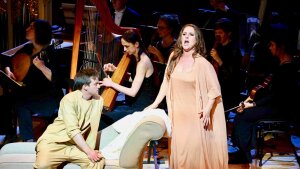
Ever since it was delivered to Gwyneth Wentink in early April, the instrument has been in the spotlight: the brand-new triple harp commissioned by the Musical Instrument Fund and built by the German master luthier Claus Hüttel. Gwyneth Wentink and the harp are currently touring with Sir John Eliot Gardiner’s Baroque orchestra, performing Handel’s opera *Semele* at top venues in Paris, Barcelona, London, Milan, and Rome. A brilliant debut.
The triple harp is famous for its enchanting solo in Monteverdi’s first opera. As Orpheus’s lyre, it lulls Charon to sleep so that Orpheus can bring Eurydice back from the underworld. “Hypnotically beautiful,” is how John Eliot Gardiner described the sound of the Baroque harp. It was he who asked Gwyneth Wentink in 2014 if she would like to play the triple harp in his production of *Orfeo* with the English Baroque Soloists. Gwyneth: “For me, that was an exceptional opportunity to learn a new instrument, study Baroque music, and perform my first triple harp concerts with the outstanding musicians of the English Baroque Soloists and the Monteverdi Choir. It was a major challenge and a period of significant growth.”
The triple harp, the predecessor of the pedal harp, was developed in Italy in the 16th century. Instead of a pedal to control the pitch, the Baroque harp has three parallel rows of strings. The two outer rows—a longer row of slightly lower-pitched strings and a shorter row with a slightly brighter tone—are tuned diatonically, just like the white keys on a piano. The middle strings are chromatic; they follow one another in equal half-step intervals. To play the middle row, you must pluck the strings with your fingers between the outer strings. This requires a special technique that you must master.
In 2016, Gardiner approached Gwyneth again for a major Monteverdi project: Monteverdi’s three operas and his Vespers. “During this project, I played on an instrument rented from the orchestra. And because we performed the operas in different keys, we needed a second triple harp. So I bought a smaller version of the triple harp myself—one that’s suitable for flying with. I’m still paying it off. At the same time, I really wanted to have a full-sized triple harp of my own for the upcoming projects with the English Baroque Soloists. I’m absolutely thrilled to have been loaned this magnificent large triple harp, built by master luthier Claus Hüttel! And I’m incredibly grateful to everyone who made this possible.”
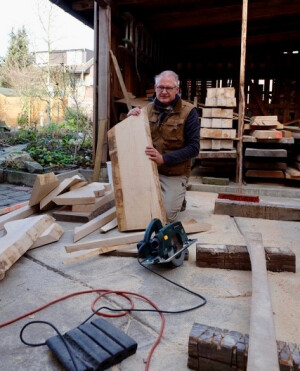
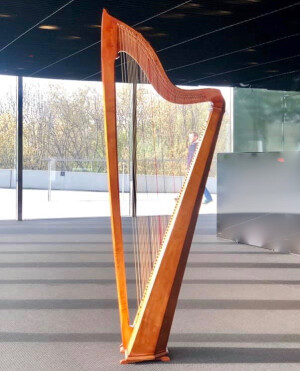
Claus Hüttel is a renowned German harp maker who has been passionate about historical instruments for more than 20 years. The sound of his first Celtic harp opened the door to the world of early harps for him. He immersed himself in a thousand years of European harp history, visited every museum and collection, and documented more than 30 original instruments. “I believe it’s important to work just as the harpmakers of the past did. By following their principles and their craft, I hope to achieve a sound that is as authentic as possible.”
Gwyneth and Claus were in close contact throughout the construction process. He sent her photos of each new phase. She had clear ideas about the decorative elements. Gwyneth: “I wanted to keep it as simple as possible. Fortunately, Claus was on the same page. No black or elaborate decorations. Just simple and elegant.”