The new...
Guarnerius?
Just over a year ago, violinist Moniek de Leeuw was granted the exceptional opportunity to purchase her violin from the Musical Instrument Fund. At that time, she had been playing for nearly four years on an instrument built by Bas Maas in 2005, a copy of an 1801 Cuypers. The Musical Instrument Fund rarely sells an instrument from its collection, but in Moniek’s case, there were few objections. The fund immediately commissioned Bas Maas to build a new violin, so that the composition of the collection would remain unchanged.
De Pijp
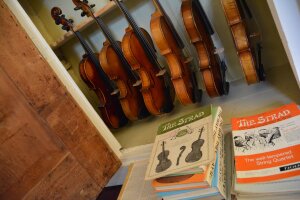
In June of this year, we received word that the violin was ready. Collection manager Geertje rode her bike to Bas Maas’s workshop one Friday morning to pick up the violin. Bas works with his two assistants in Amsterdam’s Pijp neighborhood. The workshop used to be a cozy little cigar shop. The original interior from 1880 fits perfectly with his “old-fashioned” violin shop. “Old-fashioned” because the service is virtually comprehensive: new instrument construction, sales, rentals, restoration—and you can even just stop by for a new string. All string players—professionals, amateurs, and children—love coming there.
Copy
With this new acquisition, Bas has outdone himself. His Cuypers copy, which was part of the Musical Instrument Fund’s collection, is a magnificent instrument. Nevertheless, he expressed a desire to draw his inspiration for the new violin entirely from violinist Ilya Grubert’s instrument: a Pietro Guarneri of Venice “ex-Wieniawski” from 1723. That was an exciting prospect for the Musical Instrument Fund as well!
Research
He did a lot of research, made sketches, pored over all sorts of details, and had to make many decisions: which wood, what dimensions, and how do you replicate Guarneri’s characteristic “imperfections”? For the top, Bas chose a unique piece of 140-year-old wood from the collection of the late Max Möller. And to improve playability, the violin is, for example, 1.5 millimeters shorter than the “ex-Wieniawski.” On the scroll, the marks of the gouge and the irregularities in the surface are clearly visible. The Guarneris, after all, did not strive for perfection in the finish: they considered the overall lines more important, and that lends the instrument tremendous character. To the eye, the violin thus exudes the spirit of 1723, not 2017.
New Italian
As of this writing, the new Bas Maas is on trial with a young violinist. There’s a good chance she’ll choose it! You’ll then be able to hear it in a concert hall soon. And perhaps you’ve already heard the violin on Podium Witteman in early September, when this “new Italian” went head-to-head with an “old Italian.” Are you excited yet? Bas plans to copy the “ex-Wieniawski” again, now that he has the knowledge and experience. The “new Guarnerius” has clearly caught the bug. You know where to find him now—in Amsterdam’s Pijp neighborhood…