Talent

Sasha Witteveen
plays a
double bass
from Gaspero Piattellini
from Gaspero Piattellini

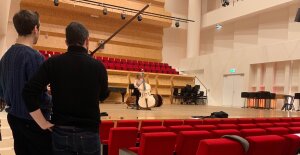
"And? How does it feel?" Olivier Thiery calls out from the audience to Sasha Witteveen on stage. Last week, Sasha had the opportunity to try out nine double basses. The 15-year-old double bass student submitted an application to the Music Instrument Fund for a bass that would support her promising progress.
Thanks to a generous donation from a dedicated private donor, we were able to start looking for a beautiful double bass for our collection—and for Sasha. We organized a sound test in the Haitink Hall at the Conservatorium van Amsterdam. The plan was to test four instruments, but as time went on, more and more top-quality double basses were submitted for consideration.
Nine double basses are carried onto the stage and unzipped out of their cases. Each one is more beautiful than the next. A new Italian instrument, a Landolfi model, custom-built for Sasha by Sergio Scaramelli of Ferrara—she visited his workshop last summer during an Italian music festival. Two 19th-century Italian instruments, a slightly younger Southern Italian model, a large French instrument, three beautiful German instruments, and a stunning unvarnished Dutch instrument, still in its natural wood finish. Maker Jurgen Preyer: “The sound can still go in any direction; it still feels completely free.” And a special bass with a beautifully flamed back made of shell maple. This instrument once belonged to Eduard van Beinum.
Fortunately, Sasha is assisted in this nearly impossible choice by two bass greats: her teacher Olivier Thiery, a double bassist with the Concertgebouw Orchestra, and his former student Ricardo Neto, recently appointed bassist of the Rotterdam Philharmonic Orchestra. On the one hand, it’s a real treat to have so many beautiful instruments and such a wealth of bass expertise gathered in one place. On the other hand, it’s incredibly nerve-wracking, especially for Sasha herself. In the audience, in addition to two collection curators from the Musical Instrument Fund, there are also six double bass connoisseurs, builders, and restorers. I’m here to listen in and eavesdrop on this double bass comparison, and I’m very curious to hear how the basses sound in such a beautiful, large hall when played by such top-notch bassists.
When choosing a bass for Sasha, it’s not just about the sound, but also whether the bass suits her in terms of shape and size. Sasha plays and sees what feels right. The heavy French bass is ruled out, as is the large German one. Then Olivier and Ricardo take a closer look at the instruments. Sasha moves into the hall. “It’s so nice that Ricardo came, too. I’m mostly familiar with Olivier’s playing. Now I can really focus on the sound.” Heavy rolls, high glissandos—the bassists pull out all the stops. Sasha listens, plays, and weighs her options. The double basses move from left to right on stage—the “yes-no piles”—and two hours later, two remain. A very young one and a very old Italian one. Sasha brought both of them along to get to know them better and to play them intensively in Olivier’s lessons.
We got the news today. It’s the Scaramelli! Sasha: “That one suits me best. It feels like it was made just for me in every way—the sound, the shape, how easy it is to play. I’m really happy with it!” By the way, that spry old Italian wasn’t going back home just yet. Olivier was very impressed with it and passed it on to a fellow bassist to try out.