Talent

Artem Belogurov
plays a
grand piano
from Gerard Tuinman
from Gerard Tuinman
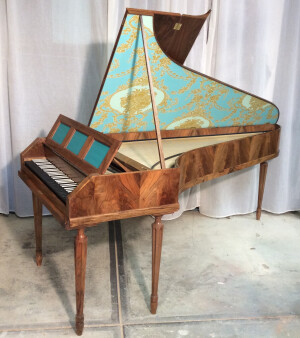
“With the bare wooden heads, the fortepiano explodes under your fingers if you’re not careful. And with the leather on the hammers, you get timbres that range from flute-like in the upper register to growling and bassoon-like in the lower register.” Gerard Tuinman built a fortepiano with two interchangeable actions for the Musical Instrument Fund. The instrument was recently delivered to its first player, Artem Belogurov.
Artem Belogurov graduated cum laude from the Conservatorium van Amsterdam with a degree in harpsichord and fortepiano. He applied to the Musical Instrument Fund for a fortepiano suitable for a broad repertoire of early music. Together, we settled on an extraordinary instrument by Gerard Tuinman. Artem: “I’ve played several of his instruments. They’re crafted with great attention to detail and after careful study of the originals. And they have a tonal quality that comes close to the beauty of historical instruments.”
Tuinman built a replica of a 1783 Stein fortepiano with a special feature: two different action mechanisms—one with bare wooden hammers and one with leather-covered hammer heads. It is the only instrument with a dual action mechanism in the Netherlands and the second of its kind in the world.
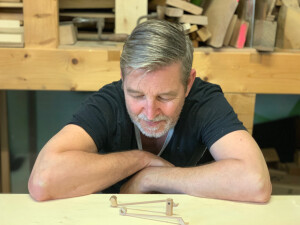
Artem: “This fortepiano gives me the unique opportunity to perform the 18th-century repertoire with two completely different sounds. Composers such as Mozart, Haydn, and Beethoven were also familiar with fortepianos that offered a wide range of tonal qualities.”
Back then, fortepianos were like today’s computers; they were evolving at breakneck speed. Every new builder added new special effects: special registers that imitated the sound of other instruments such as the harp, lute, or bassoon. These so-called “Veränderungen” are operated by pushing a wooden lever upward with your knee. There are known advertisements from that time in which instruments are touted as having up to thirty different “Veränderungen,” as if they were car accessories.
Following the harpsichord, which always plucks the strings with the same intensity, musicians in the late 17th century sought an instrument with greater nuance and expression. Around 1700, Bartolomeo Cristofori in Florence designed a mechanism in which the strings are struck by leather-covered hammers. This gave the instrument a rounder tone and, very importantly, dynamics. By applying more or less pressure to the keys, it suddenly became possible to play both loudly and softly. A new type of instrument was born. While Mozart’s touch was still very articulated, in keeping with the harpsichord, Beethoven’s playing was much more legato, already more romantic. One could say that playing changed from “speaking” to “singing.” It was the Saxon organ builder Gottfried Silbermann who introduced Cristofori’s “clavicembalo con piano e forte” (later “pianoforte” or “fortepiano”) to Germany.
A student of Silbermann’s, Johann Andreas Stein, put a new spin on the fortepiano in the late 18th century. He was inspired by the instruments of Pantaleon Hebenstreit: “Pantaleons,” a sort of king-size version of the hammered dulcimer. Stein replicated the Pantaleon sound in his fortepianos by using bare wooden hammers that struck the iron strings directly. The sound was hard but dynamic. Around 1783, he stopped using the bare hammers and began attaching small pieces of leather to the hammer heads.
Gardener: “My fortepiano is a replica of an instrument from this period: the 1783 Stein fortepiano from the collection of the Grassi Museum in Leipzig. And it’s designed so that you can slide two different action mechanisms into it. An authentic Mozart performance before intermission, followed by a genuine Beethoven piece after intermission? That’s possible.”
“With the bare wooden heads on the hammers, the fortepiano explodes under your fingers if you’re not careful,” says Tuinman. “And with leather on the hammers, you get timbres ranging from flute-like in the high register to growling and bassoon-like in the low register.” Sometimes almost beastly on the inside, on the outside Tuinman’s fortepiano is a beauty. The case is veneered with French walnut, and the keys are inlaid with ebony and bone—in keeping with the French fashion of the time, exactly the opposite of today’s piano: the black keys are white and the white keys are black. “And then the question arose: How do we decorate the lid? On old instruments, it’s covered with paper that’s often stamped with a delicate pattern. I went looking for something similar and fell in love with a chic English wallpaper featuring large, patterned flowers. Something a bit more eccentric,” Tuinman admits with a chuckle. The music stand was covered in deep blue silk. “There are some old instruments where jute was used—very sparingly. I thought this was more appropriate.”
Gerard Tuinman’s fortepiano is the final piece in the “Vogelaar Collection” of the Musical Instrument Fund. Thanks to a generous private donation from Willem Vogelaar, a total of seven high-quality instruments have now found their way to top musicians. A grand piano, two double basses, two cellos, a violin, and now the fortepiano for Artem. His plans for the near future? “The sound of the bare wooden hammers is practically unknown to modern audiences. In my performances and recordings, I’m going to explore the 18th-century repertoire using both types of action to get a better idea of how this music sounded when it was written.”