Talent

Remi Kazukauskas
plays a
alto flute
from Eva Kingma
from Eva Kingma

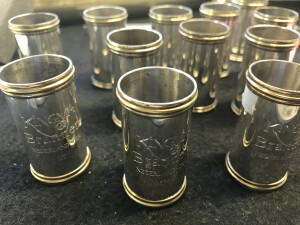
On the workbench lie gleaming headpieces, shiny valves, and sparkling gold tubes. Together with two donors, we’re in the workshop of flute maker Eva Kingma in Grolloo. A spark is immediately ignited. In no time at all, Peter and Olga Houbolt are bent over the drawers of parts with Eva. They want to know everything about her work and about the alto flute she’s building for the Musical Instrument Fund thanks to their donation. With a little luck, the instrument will be ready to go to the silver plater before the end of the year.
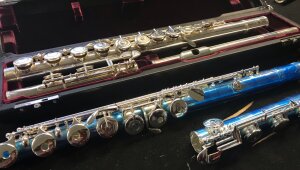
In early 2018, Remi J. Edson submitted an application to the Musical Instrument Fund for an alto flute with an open-key system. A sought-after instrument for a jazz musician like him, who loves to experiment and draw exotic sounds from his flute. When he heard that Eva Kingma could begin building an alto flute for him, he was over the moon.
The flute is being built thanks to a donation from Peter and Olga Houbolt. They’re very curious about the building process. In Eva’s workshop, they want to know all the blacksmith’s secrets. And they’re just as surprised as we are when Eva reveals that a famous motorcycle racer is responsible for all those finely turned parts in the drawers. Eva: “I work with Egbert Steuer, the sidecar racer and multiple world champion, who’s known to everyone in Drenthe. When I moved here, he had just retired from racing. He’s an incredibly skilled technician. At home, he has a metal-turning shop for his motorcycles. And now he also turns just about anything you can think of. Have you seen that mouthpiece on that low-pitched double bass? It looks just like an exhaust pipe. Perfect for Egbert, too!”
Eva’s father was a sculptor; her mother, a pianist. She grew up surrounded by classical music in her father’s workshop. “From the age of two, I was tinkering with the most dangerous tools, much to the horror of the neighbors. When I was twelve, my uncle, Dirk Kuiper—a flute maker and flutist with the Concertgebouw Orchestra—gave me a flute, and I became fascinated by the mechanics of it. I enjoyed playing it, but I also regularly took the flute apart. At one point, absolutely no sound came out of it anymore. My uncle invited me to come fix the flute. After that, I never left his side.” She joined his staff, took over his workshop years later, and moved her studio to Grolloo in 1989.
She has developed a great deal of expertise. Flutists from Japan and the United States come to Drenthe for her unique low-pitched flutes with that distinct Kingma sound. Eva: “I always try to achieve a characteristic sound—consistent and balanced across all octaves. A powerful, dark, and full-bodied sound. I love the sound of the wooden flute—that’s what I aim to emulate. My heart lies with the low-pitched instruments.”
In addition to their sound, Eva’s flutes stand out because of their ergonomic design. “A flute should feel balanced in your hands, and the keys should be easy to play. People with small hands, crooked fingers, short pinkies… I customize the flute for them. That’s what I love most: finding special solutions—for special hands and for new musical challenges.”
Together with her uncle, she designed a system with open keys for the alto and bass flutes. This was a huge breakthrough in the international flute world. Using the same number of fingers, there were suddenly infinitely more artistic and musical possibilities—such as multiphonics and glissandos. Non-Western music became much more accessible, and jazz musicians were delighted with the new effects. Leaning against a post in her studio is Eva’s latest experiment: the immense sub-subcontrabass flute. A curved tube more than ten centimeters thick with keys as big as tea saucers. For now, the top key still serves as a hook for her leather aprons. But her eyes sparkle when she talks about it.
First, the alto flute for Remi has to be ready. That won’t be until the end of January. Along with his flute, Eva will give him several mouthpieces so he can try them out at his leisure in different concert halls. “A mouthpiece is so personal. And that’s where the real mystery of the flute lies. The shape of the blowhole, its placement, the way it’s rounded… it determines the sound, much more so than the tube itself.”
Peter and Olga Houbolt are looking forward to Remi’s first concerts with his new flute. And as they’re leaving, Eva extends a warm invitation for them to attend the fifth Grolloo Flute Session this summer—the international festival for flutists that Eva organizes every year. Chances are they’ll be there, too. The spark has been ignited.