DIY Workshop at
Guust François
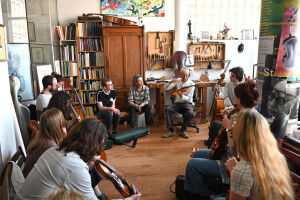
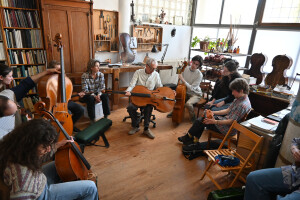
What can you do yourself to maintain your instrument, and when should you consult an expert? During our repair workshop for string players, led by violin maker Guust François, twelve violinists and cellists receive tips from the master. It’s packed to the brim. Scattered haphazardly among the workbenches, saws, and stacks of wood, they ask Guust every question under the sun and learn from him—and from each other—about warped combs, slow bows, peg issues, and mysterious buzzes.
curious and driven
Guust begins with an explanation of the instrument’s design and construction. Where do most of the forces and stresses converge, and how does that affect the way you handle your instrument? He then goes through all the parts of the violin and cello and discusses how to care for your instrument.
Participants in this workshop include both borrowers from the Musical Instrument Fund and musicians from the SEM Academy, the development program run by the Stichting Eigen Muziekinstrument foundation that is aimed at music graduates. Both groups are equally curious and driven to get the most out of their instruments.
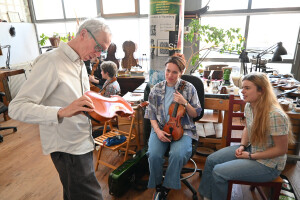
Oh no, my comb is crooked!
Special attention should be paid to the adjustment of the bridge. Is it firmly positioned on its two legs, perpendicular to the top, and are the strings not worn too deeply into the bridge? The advice is clear: check this regularly. If your bridge is misaligned for too long, the wood will warp and the bridge will need to be replaced. And if everything is in order, your instrument will sound so much better.
Everyone checks their own instrument. Soon, comments like “my bridge is S-shaped” and “there’s space under my footpiece” start coming up. Luckily, Guust is watching and explains how you can fix this yourself. Or not. “This one is really too warped; you’ll have to take it to your violin maker.”
Clean
The participants ask which cleaning products they should use. Guust advises against using alcohol and polishes. “Alcohol can damage the varnish, isn’t good for the strings, and actually rubs dirt deeper into the fingerboard. For a thorough cleaning, it’s best to take your instrument to your luthier.” The best cleaning tip remains: prevent your instrument from getting dirty. Clean it immediately after use with a clean, soft, lint-free cloth. And use a separate cloth to remove rosin residue from the strings, the bridge, and the top.

Champagne Cucumber
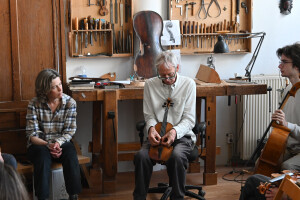
Sybren Holwerda surprises us with a unique tip. While Guust recommends using a dry chamois to clean the strings, Sybren suggests using a champagne cork. He pulls two out of his case and tosses one to Guust to try it out. It works!
Bow talk
The bow is also covered. “The few parts on it need to work perfectly. Tip: When tensioning the bow, gently press your finger against the bow sleeve. This way, the screw doesn’t have to exert as much force, and the mechanism stays in top condition longer.”
There’s plenty of time to answer personal questions. We also discuss string setup and a tuning peg that isn’t turning smoothly. Guust examines a mysterious buzz in Charlotte Basalo’s violin. It’s a tricky one, but after a while, by tapping along the edge, he does indeed locate a slight gap. After two hours filled with discussion and educational moments, Guust concludes: “I hope you’ve gotten to know your instrument better and feel more comfortable making adjustments to it.”

Photography: Katrien Kloos
Want to join in?
For musicians who have an instrument and/or bow on loan from the Musical Instrument Fund:
The Musical Instrument Fund aims to organize a repair workshop twice a year in collaboration with an expert. Previous workshops have featured cellists, violinists, and double bassists. The upcoming repair workshop will be for pianists. Another workshop for violinists and cellists is also scheduled for this fall.
Are you interested? Let us know! Send an email to Geertje.
Send an email