Talent

Koninklijk Conservatorium
plays a
grand piano
from J.B. Streicher (company)
from J.B. Streicher (company)

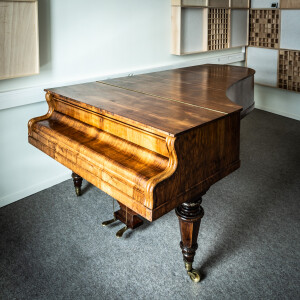
A few years ago, the Musical Instrument Fund was able to add a rare, late-Romantic Streicher grand piano to its collection. The grand piano has been loaned to the Royal Conservatory in The Hague, allowing a large group of students to play this historic instrument. The conservatory features the instrument prominently in various concerts, competitions, master classes, and music recordings. The instrument is currently undergoing extensive restoration, during which something remarkable was discovered.
Composer Johannes Brahms (1833–1897) moved to Vienna around the age of thirty. There, he played mainly on Bösendorfer or Streicher grand pianos. But a Streicher was definitely his favorite, especially at home. At that time, the company was experimenting with the innovations that Steinway was bringing to Europe from New York. Brahms tried out a new Streicher model and wrote to Clara Schumann: “I have a beautiful Streicher grand piano. With it, he wants to show me his latest achievements, and I believe that if he were to make a similar one for you, you would be delighted with it.”
In 1870, Emil (Johann Baptist’s son) Streicher gave Brahms a grand piano (built in 1868) for his apartment at Karlsgasse 4. The instrument remained with him until his death in 1897. He was very fond of it. The specific model that Brahms owned was manufactured until 1874. The Streicher in the collection was originally dated 1876, but it turns out it must actually be from 1874.
The grand piano is currently undergoing extensive restoration in Ruiselede (Belgium) by Chris Maene. In books about the Streicher company and Brahms’s grand pianos, he found the serial number, along with the notation: “NL privat.” The documents also revealed that the grand piano was built in 1874, allowing Maene to confirm that it is indeed a “Brahms grand piano.”
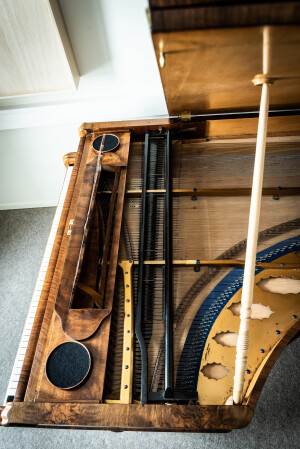
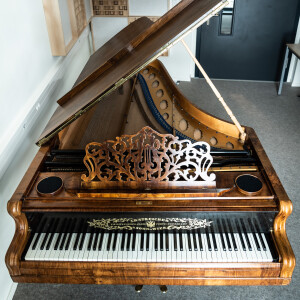
Pianists and teachers at the conservatory identified areas for improvement in terms of playing comfort and tonal balance. These improvements can be implemented through a comprehensive overhaul of the keyboard and action. Experts advised the Musical Instrument Fund to also address a few age-related defects, including those affecting the soundboard and the sound post. The fund then commissioned the firm Maene to carry out what would now be a full-scale restoration. The Royal Conservatory has a replacement instrument on loan from Maene; the restoration will take three months.