Instrument

violin
Jacques Boquay
Paris,
1719
played by
Jiska ter Bals
Jiska ter Bals

*± 1680 , Lyon †± 1740 , Parijs
According to tradition, Jacques Boquay was born in Lyon. The year 1700 is also mentioned as the year he began working as a violin maker in Paris. His first instruments bearing a label indicating that he was working in Paris did not appear until around 1710. It is possible that he did not learn the trade until after his arrival in Paris or that he worked for another maker. The Parisian guild to which violin makers belonged imposed uncompromisingly high standards of craftsmanship, which meant it could take years before a maker could set up his own workshop.
After arriving in Paris, he found a studio on Rue de la Juiverie. It was located in the old Jewish Quarter on the Île de la Cité, a busy thoroughfare between the Petit Pont and the Pont Notre-Dame. Later, he moved to a street in a significantly quieter and nicer neighborhood, the Rue d’Argenteuil. It was located on the right bank of the Seine, not far from the Tuileries and the Palais Royal. He would continue to live there for the rest of his working life. At the time he was working there, the street had little more than 40 houses, ranging from a locksmith’s shop to a small theater.
Jacques Boquay did not build all the violins he sold himself; he also dealt in new instruments made by others. After his death, twenty-nine violins by various makers from the Lorraine region were found in his workshop. He had an apprentice, a “garçon,” who was referred to as Treuillot or Trevillot in letters that were discovered.

Marin Marais, (workshop of) André Bouys, 1704
Italian instruments were very popular among the musicians of the French court. As far as the making of stringed instruments was concerned, the court had maintained a relationship with the Amati family of Cremona for many years. On two separate occasions, Andrea Amati—who worked alongside his two sons—had been commissioned to supply instruments. The influence of other Italian luthiers was also evident in Paris. Instruments by Nicolò Amati, Antonio Stradivari, Carlo Bergonzi, and Giovanni Battista Grancino were represented in both court orchestras. The most renowned of these was undoubtedly “Les Vingt-quatre Violons du Roi,” which always performed at royal ceremonies.
That Italian influence gradually came to an end. Under the influence of growing nationalism, the court stopped having stringed instruments built in Italy. French makers crafted them according to the musicians’ needs and preferences.
Around 1710, Jacques Boquay was commissioned to supply several instruments to the Chapelle Royale of Louis XIV, the Sun King. One of these was a basse de violon (the predecessor of the cello). The delivery coincided almost exactly with the coronation of his successor at the Château de Versailles. That event was graced by 200 musicians. In 1711, Jacques Boquay got married. Paris had grown enormously during the reign of Louis XIV, and under his influence, a favorable climate for music, ballet, and opera had emerged.
After the Sun King’s death in 1715, his son Louis XV began hosting concerts in a hall at the Tuileries that was located near Boquay. Lully composed music for these concerts, often for large ensembles. Marin Marais, himself a virtuoso violinist, composed an enormous body of work for the violin, some of which was also performed at the Tuileries.
There is a bass violin made by Boquay bearing the inscription: “Sit nomen Domini benedictum” on the side, presumably from 1720, with the royal coat of arms painted on the back. He must have built it for one of the two orchestras that were based in Versailles under Martin Richard de Lalande, where such an instrument was in use.
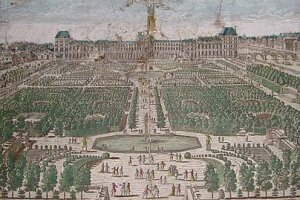
The Tuileries in the late 17th century
Jacques Boquay is often mentioned in the same breath as another Parisian luthier, Claude Pierray. Pierray’s instruments are slightly more elegant, while Boquay’s are generally heavier and demonstrate good, though not exceptional, craftsmanship. Dendrochronological and comparative studies of various Parisian instruments from around 1693 show that there were still a few makers who must have had the same teacher as Boquay. Sylvette Milliot, an authority on Parisian violin making, distinguishes three periods within a school referred to as “Vieux-Paris.” Pierray and Boquay led the first generation of this school, which spanned the years 1700 to 1740. The fact that a “Boquay school” was further distinguished within this period suggests that Charles Boquay must have had several students or followers.
The wood that Jacques Boquay used was of good quality. It was purchased collectively by several woodworking artisans and delivered within the city to the banks of the Seine.
Boquay did use Amati’s model for his instruments, but he applied a different finish: a base coat of bone glue without pigments, over which he applied a mixture of drying oil and pine resin that later caused a natural, dark discoloration. On some instruments, a third layer containing colorants has been found. The varnish Boquay used was usually dark red and not very transparent.
Given the relatively large number of violins by him that still exist, Boquay was a prolific maker.

Source: Tarisio
Boquay used two different printed labels:
JACQUES * BOQUAY / RUE DARGENTEUIL / A PARIS 17..
The other one has a decorated border,
Jacques Boquay / Rue d’Argenteuil / Paris 17th arrondissement..
Dufour, R., French Music in the 17th and 18th Centuries, 1970, Paris.
Bocour V, 2016, Handbook of materials of string musical instruments.
Dufourcq, N., 1965, “Music, People, Instruments, Works…,” Paris.
Milliot, S. *Unpublished Documents on 18th-Century Parisian Instrument Makers*, Paris.
Milliot, S., 1960, *History of 18th-Century Parisian Stringed Instrument Making*, Spa
Gétreau, F. Parisian Instrument Makers and Luthiers, 17th–19th Centuries. Edited volume, Paris.
The Strad, May 1892. London.