Instrument

violin
Hendrik Jacobs
Amsterdam,
± 1690
played by
Mevrouw Maria-Paula Majoor
Mevrouw Maria-Paula Majoor

*± 1629 , Amsterdam †1704 , Amsterdam
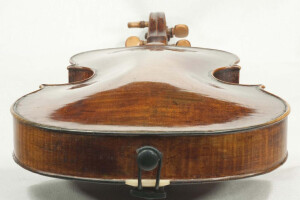
Virtually nothing is known about the early years of Jacobs’ life; for example, we do not know where or when he was born, nor where he learned his trade. The first document we encounter regarding him dates from 1654: a marriage certificate in which he is listed as a “fiole maker,” something that was quite unusual for that time, since until then most instrument makers referred to themselves as lute, viola da gamba, or zither makers. His wife, Femmetje Jans, already had three children from her previous marriage, as evidenced by a rediscovered marriage certificate. Her youngest son, Gijsbert Verbeek, would go on to become one of the finest violin makers in Dutch history under Jacobs’ guidance. That same marriage certificate contains two other interesting details: it states that Jacobs’ parents were no longer alive and that he resided on Sint Antoniesbreestraat. The painter Rembrandt van Rijn lived on the same street at that time.
We also come across Jacobs in a detailed inventory document from 1670, drawn up after the death of Grietje Boumeester, widow of zither maker Gerrit Menslage. He still owed Boumeester’s heirs 19 guilders and 10 cents. A few years later, we find another marriage record for him, dated 1676. This time, he married Sibilla Barents ten Bergh, who also had a child from her previous marriage. The child’s name is Pieter Rombouts, who, decades later, after Jacobs’s death, would take over his workshop.
With the exception of just a few notarial deeds—in which he is listed as a witness to a marriage or the baptism of one of his stepsons’ children—we know almost nothing about Jacobs’s life. As far as we know, Jacobs had no children of his own.
Nevertheless, the year 1692 must have been a turning point in Jacobs’s life, for on January 7 of that year, he and his wife had a joint will drawn up. The reason for this is not stated in the document, though it does note that both were in good health. This turning point is also evident in his work, as it is precisely from 1692 onward that by far the largest number of instruments attributed to him are known. The large surviving group of instruments suggests that production numbers also increased: while no instruments made by him are known to exist prior to 1680, and only a few appear from that point onward, more than sixty instruments from 1692 onward have survived. From that period onward, his workshop dominated the market and produced instruments of exceptional quality. Thanks in part to this period, he emerged as the master craftsman for whom he is known today. During this specific period, he was assisted by Rombouts and perhaps a few others, as the name Hendrik Ravekes also appears several times in connection with the workshop, suggesting that this maker was also a student of Jacobs. Jacobs passed away in late December 1704 and was buried on New Year’s Eve in the Nieuwezijds Kapel (today Rokin 78).
A wide variety of instruments were crafted in his workshop: violins, cellos, violas da gamba, tromba marinas, and even pocket violins. By far the most common instruments are violins, which vary in model and size; decorative elements such as the scroll, edging, and corners may also differ (subtly) from instrument to instrument. His work was strongly influenced by the Italian luthier Nicolò Amati, as was the work of many Amsterdam luthiers of that time. Although Jacobs was able to match Amati’s quality best, we do not refer to them as copies. Perhaps “homage” is a more appropriate term, for it is not that his skills were insufficient to accurately copy an Amati violin. This is particularly evident in the scroll of a 1699 violin in the collection of the National Musical Instrument Fund; that scroll is identical to an Amati’s, but other details are distinctly Jacobs’s personal style. He therefore simply chose not to copy the entire model.
This is consistent with the general thinking of the time, which is also evident in the art world: direct copies are not made by masters, but only by students trying to master a particular style or technique. This ideology was already described in the early 15th century in Cennino Cennini’s book *Il Libro dell’Arte*. It was almost an unspoken golden rule among classical painters and sculptors, but you also see this in early violin making; people drew inspiration from the work of their master or another artist, but only details were copied, leaving sufficient room for personal interpretation, characteristics, and ideas. In this way, something both familiar and new was created. The Amsterdam violin makers mastered this centuries-old way of thinking and approach, and Jacobs was clearly a master of it, for despite his recognizable sources of inspiration, Jacobs’ instruments do indeed possess a character all their own.
Throughout his career, Jacobs was never hesitant to try something new; from his earliest known instruments to his last violins, one can see great creativity, freedom, and artistic development. For example, in the 1680s, he crafted violins from Brazilian rosewood (known at the time as “Sakerdaan”), which must have been groundbreaking even then. But at the same time, in that same decade, he also managed to build a beautiful, refined, and ornately decorated viola da gamba that can stand shoulder to shoulder with the work of any world-renowned luthier. This viola da gamba is now part of the Rijksmuseum’s collection. Within his own style and working method, Jacobs allows himself so much freedom that hardly any two instruments are alike. He makes large and small models, wide and slender, with high and low arches; even the length of the corners can vary from instrument to instrument. While his ground coat is always the same (a very intense and deep golden-brown color that creates a warm and reflective appearance), his varnishes vary greatly in texture and color. Jacobs uses the entire available palette of varnish colors: from an almost colorless varnish to light amber, orange, deep red, and bright brown shades. And always of the highest quality.
Despite the highly refined finish, slight tool marks are still visible, particularly in the corners, the scrollwork, and the interior. One of the distinctive features is the use of dogshark skin. This 17th-century “sandpaper” was used to finish the edging and scrolls. Furthermore, linen can be found on the inside of the ribs of his instruments; unfortunately, this has been removed from many instruments by later restorers because they mistakenly assumed it had been added during a repair and thus failed to realize that it was the work of Jacobs himself. The use of linen is unusual in Amsterdam; Jacobs’s workshop was the only one where this method was employed.
Jacobs mastered every aspect of his craft, and each of his surviving instruments is, as a result, a masterpiece. In addition to his genius as a craftsman, he proved to be an exceptional teacher and source of inspiration, for everyone in or around his workshop also became a master of the craft, each with their own individual style. This, combined with the beauty of his instruments, rightly makes Hendrik Jacobs the greatest master violin maker in Dutch history.
D.J. Balfoort, 1931 *Dutch Violin Makers*, H.J. Paris, Amsterdam.
Bolink, J., Giskes, J., Lindeman, F., and Stam, S., 1999, 400 Years of Violin Making in the Netherlands, Amsterdam.
Amsterdam City Archives, accessed in 2025


