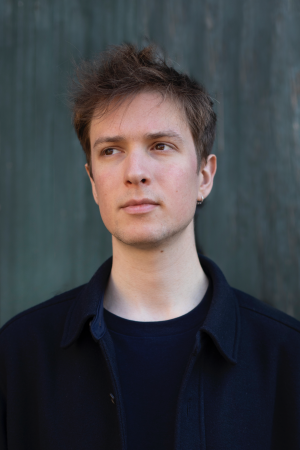
My name is Mattias Spee. I am a pianist, composer, and improviser, and I have a beautiful Grotrian-Steinweg grand piano on loan from the Musical Instrument Fund. You can find my website here.
In 2013, the Musical Instrument Fund loaned me a Bechstein grand piano, built in 1911. Before that, I had an upright piano in my living room, but at some point, that instrument no longer met my needs and expectations regarding my musical studies: a grand piano would. Non-pianists have often asked me what the fundamental difference is between an upright piano and a grand piano. The physical differences are obvious, but generally speaking, they produce almost the same sound, right? Yet there is indeed a difference between the two types of instruments.
Because the hammer head on a grand piano moves from top to bottom when a key is struck, the touch of a grand piano is distinctly different from that of an upright piano, where the hammer head moves from back to front. A grand piano also has longer—and therefore thinner—strings, which result in a different touch and a greater variety of possible sounds and timbres. And because the strings on a grand piano are thinner, the soundboard has a larger surface area, and the pedals function differently, it’s possible to experiment with and play around with resonance and overtones on a grand piano. So a grand piano is indeed different from an upright piano.
I always play a grand piano during performances, so it’s important to be able to practice on one to gain experience and develop a feel for controlling touch and tone. The better a pianist knows their instrument, the more extensive their “palette” is when creating a “musical painting.” For the reasons mentioned above, and having reached a certain point in my musical journey of discovery, I eventually felt that I was ready to have a grand piano at home.
The Musical Instrument Fund then loaned me an instrument from grand piano manufacturer C. Bechstein with the serial number A.102.214. Before it came into the possession of the Musical Instrument Fund, this grand piano had belonged to the famous conductor Anton Kersjes. The grand piano was 1.84 meters long and therefore not very large, but since I used it primarily for piano practice (in my living room), these dimensions were ideal. After playing this grand piano for six years, I was ready for a different, more modern grand piano.
My development as a pianist, the rehearsals with other musicians at my home, and my love for contemporary music meant that the Bechstein, which I had enjoyed playing for six years, no longer fully met my expectations for an instrument. That’s why I was incredibly happy to be able to switch grand pianos. The Musical Instrument Fund offered me a Bösendorfer, which better suited my needs at the time. When I had to move to a smaller space, I switched instruments again. The major advantage of this was that I received a Grotrian-Steinweg grand piano with three pedals. Both the Bechstein and the Bösendorfer had only two pedals. As I shifted my focus more toward composition, improvisation, and contemporary music, I often found myself missing that third pedal. Now I can play whatever I want to my heart’s content, without being limited by the instrument’s technical capabilities.
The Musical Instrument Fund has contributed enormously to my development as a pianist and composer by first lending me the Bechstein, then the Bösendorfer, and now the Grotrian-Steinweg. Both instruments have greatly enhanced my enjoyment of playing. I do not perform with my instrument, as other Musiekinstrumentenfonds musicians do. Nevertheless, my instrument helps me in my development as a pianist, which benefits me during my performances.
