Instrument

cello
Wilhelm Paul Kunze
The Hague,
1923
played by
Pippa Drijver
Pippa Drijver

*1875 , Markneukirchen †1957 , Den Haag
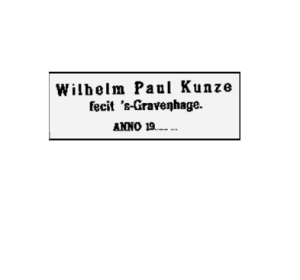
Paul Kunze worked at the Kok firm until Gerrit Kok died in 1899. The eldest of the brothers, Johan Warnaar, had already died in 1889. After Gerrit’s death, the company continued under the leadership of Gerrit’s widow. She was assisted by Paul Kunze, who had married their daughter shortly after Gerrit’s death. In 1902, Paul established himself as an independent violin maker in Amsterdam, but moved to The Hague in 1904. Paul Kunze was a rather independent but highly productive maker. As far as is known, only the violin maker Joseph Vedral worked with Paul Kunze from 1905 to 1907. Paul Kunze continued to work in The Hague until his death in 1957.
In his early days, Paul Kunze made instruments modeled after Stradivarius and Guarneri, but after careful research, he also designed his own model. This differed not only in its proportions from the instruments he had previously copied, but also in terms of finish. A key factor in this was a new impregnation method he had developed. He would immerse instruments that were still “unfinished” in a mineral-based liquid. This improved the sound and gave the instrument a beautiful, translucent appearance. He sent the first violin he built using this method to the international violin-making competition “Le Monde Musical” in Paris in 1912. There, he won first prize for its sound and finish. Later, in 1930, he exhibited a violin at the Exposition de Liège. There, too, he received an award for his entry. Beginning in 1912, Paul Kunze impregnated all his new instruments.
The violins and cello in the collection of the Musical Instrument Fund date from after that period. For this reason, it is reasonable to assume that the instruments in the fund’s collection were also built in this manner.
In 1949, Paul Kunze was one of the founders of the Dutch Group of Violin Makers.
amati.com, creators archive. Accessed in 2019.
Balfoort, D. J. (1931), Dutch Violin Makers, The Hague.
Blok, P. J., Molhuysen, P. C. (1912), *Nieuw Nederlandsch biografisch woordenboek*, The Hague.
Bolink, J., Giskes, J., Lindeman, F., & Stam, S. (1999), 400 Years of Violin Making in the Netherlands, Amsterdam.
Vannes, R. (1951) Universal Dictionary of Instrument Makers, Spa.
Haags Dagblad, Interview with Paul Kunze (no date, no location).
Couturier, L. (1947). *On the Violin, Its Makers, and Virtuosos*.


