Instrument
violin bow
Roger Gérôme
Mirecourt
played by
Azra Rustempašić
Azra Rustempašić

*1918 , Mirecourt †2001 , Mirecourt
Rogers’ grandfather, Louis Gérôme, had been a violin maker in Paris but moved to Mirecourt to make mandolins, guitars, and banjos there with his three sons. In 1920, the eldest son, René, established his own workshop on Quai Lebreuil, where his brothers worked alongside him. He employed a few people, while others worked for him from home. René Gérôme survived World War I as a soldier, married in 1918, and that same year welcomed the first of his four sons: Roger.
Roger began working in his father’s workshop at a young age and, starting in 1930, expanded the business with his three brothers, André, René, and Lucien. The Gérômes not only made instruments but were also known for their ingenuity and technical expertise. They devised and improved tools and machines that could be used in their craft. Roger learned the trade from an unknown—but presumably excellent—bow maker and crafted his first bows at a young age.
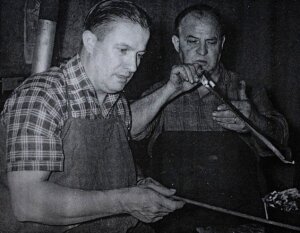
Roger Gérôme (left). Photo courtesy of Charles Espey
In 1947, he married Jeannine Devoivre, the daughter of a violin maker from Mirecourt, and together they started a business under the name “Gérôme-Devoivre.” They settled in the Bois du Four, a neighborhood in Mirecourt where other bow makers also lived. Due to industrialization, the market for bows had been flooded with dirt-cheap bows. Only makers who could boast a history spanning generations—such as the Morizot brothers, Roger François Lotte, and Charles Alfred Bazin—were still able to make a living from the craft.
Roger Gérôme initially made bows under his own name, which were sold by Philibert Décombe. Décombe was a violin maker, but he primarily dealt in accessories and wood for violin making in Mirecourt, where he was quite successful. When Philibert Décombe died in 1957, Roger took over the business. He continued to make bows himself but also sold works by Morizot and Lotte. The École Nationale de Lutherie et d’Archèterie, located in Mirecourt, had by then gained international renown and was training a new generation. Students from the school completed internships with Roger Gérôme.

Photo courtesy of A.S. Trivin © Musée de Mirecourt
Thanks to his growing prosperity, Roger was gradually able to focus on the high end of the market. Many of the canes he sold exuded luxury and elegance. The gold-mounted frames from the second half of his career were the rule rather than the exception. The designs of the shafts varied depending on the maker, but he often had the handles custom-made by specialists according to his specifications.
In 1968, he hired Georges Emile Barjonnet. This bow maker had gained a wealth of experience working for Émile François Ouchard, Cuniot-Hury, Émile August Ouchard, and Jérôme Thibouville-Lamy. He had run his own business, and after he was forced to close it, he also made bows for Charles Alfred Bazin. However, he produced his finest work for Roger Gérôme.
Thanks to his knowledge of wood and his fascination with bows, Roger Gérôme was able to select the finest pernambuco available on the market.
He stamped the bows he made during the early part of his career with “Roger Gérôme”; most bear the name “Gérôme-Devoivre.” Some were made by Lotte or Morizot, while the more expensive ones were made by Georges Émile Barjonnet.
The workshop, including the tools and materials used by three generations of the Gérôme family, was purchased in 2016 by the violin-making museum in Mirecourt.
Vosges Departmental Archives 58J Collection on Stringed Instrument Making (1894–1986)
Haine, M., 2013, Registered Trademarks of Instrument Makers from 1860 to 1919.
Millant, B., Raffin, J.F., 2000, *L’Archet: French Bow Makers 1750–1950*. Paris
Vatelot, E., 1976, French Bows. Nancy.
Tarisio, Cozio Digital Archive, accessed in 2024.