Instrument

violin
Paul Max Möller
Amsterdam,
1919
played by
Reo Pramana
Reo Pramana

*1875 , Adorf (Duitsland) †1948 , Amsterdam
After completing his apprenticeship with a master’s examination, he was hired by Heinrich Th. Heberlein. Heberlein was known as a master in the use of various varnishes and techniques that gave his copies of Stradivarius models a beautifully weathered appearance. The wood he used was unquestionably of the highest quality. He received high honors for many of his instruments. Heberlein was also widely regarded as a leading expert in the acoustics of stringed instruments. Paul Max became this violin maker’s assistant.
In early 1899, Paul Max Möller left for Leipzig to join Louis Lowendahl. There he found something quite different from what he had hoped for: not a violin-making workshop in the traditional sense, but a workshop where instruments were produced in an almost industrial manner. He soon decided to leave and sought out a more interesting workshop. He found one with Karel van der Meer in Amsterdam; he worked there for the last eight months of that year.
In late 1899, he decided to go work for Max Möckel in St. Petersburg. Although Max Möckel had only been there a short time, he quickly became known as a skilled luthier and repairman. Thanks to his knowledge and encouraging approach, he had a major influence on the employees in his own workshop and on other violin makers beyond it. During the time Paul worked for him, Max Möckel, together with the chemist Golonin, succeeded in developing a varnish that closely resembled the old Italian violin varnish.
The Russians did not have a strong tradition of violin making. Knowledge from foreign makers was therefore essential. There were many French makers in Moscow, and German violin makers had dominated the scene in St. Petersburg since 1876. They lived and worked in close proximity to one another in the neighborhood. Virtually all of the German makers had been trained in Markneukirchen, just like Paul Max Möller. Both inside and outside the workshops in St. Petersburg, the German makers met and exchanged knowledge.
The St. Petersburg that Paul Max found himself in had a thriving music scene. Many people played an instrument, and countless performances were held—as many as 30 per evening on peak nights. Violinists came from all over Europe to study at the St. Petersburg Conservatory. From 1868 to 1917, the iconic violin teacher Leopold Auer taught at the Rimsky-Korsakov Conservatory, where great violinists such as Jascha Heifetz, Nathan Milstein, and Mischa Elman studied under him.
But there was more that made St. Petersburg so fascinating; the city’s aristocracy owned many valuable French and Italian instruments. For example, General Lvov’s descendants had inherited not only a music library of formidable proportions from him, but also a large collection of violins and cellos by makers such as Amati, Guarneri, Maggini, Vuillaume, and Stradivarius. Luthiers who had been based in St. Petersburg in previous years, such as Moritz Paulus, Anton Jaudt, and Ludwig Otto, had passed away. For repairs and maintenance on these old instruments, the owners were now largely dependent on newcomers such as Max Möckel. In the workshop, Paul Max Möller undoubtedly held these instruments in his hands and was able to study them closely—which undoubtedly contributed to his knowledge of Italian master instruments. Everything he had learned in this vibrant and stimulating environment, Paul Max Möller would take with him to Amsterdam four years later.
In 1904, he returned to the Netherlands to resume working with Karel van der Meer in Amsterdam. Karel van der Meer was a former violinist with the Concertgebouw Orchestra and well-connected in the international music world. In 1892, he traded that career for that of a violin maker. After completing his training, he became a highly regarded luthier with his own workshop located practically next to the Concertgebouw. Not only did he possess a keen business sense, but he also developed into a leader who managed his ever-expanding workshop in a particularly inspiring way. This enabled him to attract talented violin makers and bow makers from abroad to Amsterdam, such as Friedrich Ernst Schmidt, Joseph Vedral Sr., Johan Stüber, Eugene Eberle Sr., Kraus, and August Toussaint. Given the great diversity of new instruments and bows that left his workshop, Karel van der Meer must have granted his employees a great deal of freedom. In this workshop, which was so important to the Netherlands, Paul Max Möller worked his way up to become the head of the workshop.
In 1908, Paul Max married Christina Henrietta Weerts, with whom he opened his own studio at Leidsegracht 63 in 1913. After moving to 34 P.C. Hooftstraat, he would finally settle in 1925 at the location where the next two generations of Möllers would also work: 15 Willemsparkweg. Paul Max not only built exquisite instruments, but he was also regarded as a great connoisseur of antique instruments.

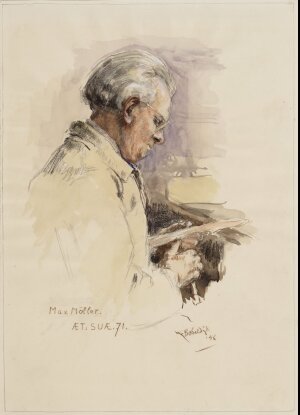
Paul Max Möller at work, drawing by Félicien Bobeldijk, Amsterdam City Archives Image Bank
Between 1913 and 1918, Paul Max primarily built new instruments. He crafted them meticulously, following the example of the great Italian masters. His viola da gambas and viola d’amores from that period also feature strikingly delicate female or angelic heads. The varnish he used for his instruments was still based on the one he had learned to make at Möckel’s workshop. Later, he would develop his own varnish, which he applied in a unique manner. This varnish was quite thick, dark red, and prone to craquelure, but it had a beautifully deep color.
After 1918, he devoted himself to collecting antique instruments and expanded his knowledge of them. He had already brought back a number of them from his travels throughout Europe. Together with the instruments he would collect on his travels between 1930 and 1935, it became one of the most interesting collections in the Netherlands.
Between 1925 and 1929, he once again focused on making new instruments. The trade in antique violins took a back seat at that time.
Even after 1935, making new instruments once again became Paul Max’s top priority. During this final period, in addition to some 250 violins, cellos, a few violas da gamba, and violas d’amore, he crafted his famous large-model violas, which were highly prized. Due to their size, these violas had such a deep tone that it bordered on that of a cello. There is a lovely story—one that cannot be refuted, but also cannot be confirmed—about the back plates of a number of large violas he made immediately after World War II. That wood is said to have come from the centuries-old maple tree that had stood in the garden of the Rijksmuseum. Due to the war, there was a shortage of everything, and the municipality decided to donate the wood from this tree to Paul Max Möller. His instruments were beloved by members of the Concertgebouw Orchestra; after the war, the string section played seven violas, several violins, and a cello made by him, and later the number of violas increased to nine. Although the sound of Paul Max Möller’s large-format violas was exceptionally beautiful, they eventually disappeared from the stage. Many violists found these instruments too difficult to play; not everyone had arms long enough or hands large enough.
A large number of bows were also made in Paul Max Möller’s workshop. Before 1945, these were mostly German models, such as those by Paul Weidhaas; after the war, bows modeled after French designs became common. Well-known are the bows with a rounded ferrule without an eye. He stamped these bows with “M. Möller” or “M Möller Amsterdam.” The bows from his workshop that were stamped “Meunier” or “Meunier à Paris” usually did have a so-called “Paris eye.”
Enel wrote from Paris about Paul Max Möller: “...since Barbé, Marchant, and Humbert, I have never seen such a sure, supple, and elegant hand in violin making, nor such a high regard for service to the art of violin making.”
Paul Max Möller laid the foundation for a workshop that would grow to become one of the leading centers for violin making and expertise in Europe. In 1935, his son Guillaume Max began working with him. His wealth of knowledge and experience was passed down from father to son. Together, they wrote the book *Italian Violin Making* in 1939. Along with Karel van der Meer, Paul Max was instrumental in reviving violin making in the Netherlands.
The Möllers’ reputation for authority would prove to be so great that, over the years, their certificates of authenticity were frequently forged for less than honorable purposes. The Möllers’ archive contains dozens of these forged certificates, and the collection continues to grow.
Among those who worked for him were Erhard Uebel, Jan Santman, and Karl Rutz, as well as the bow makers Jean-Claude Ouchard, G. Waehneldt, Robert Penzel, and, for a short time, Daniel ter Berg.
Möller M, 1955, The Violin-makers of the Low Countries, by Max Möller, Amsterdam.
Lim A., n.d., The Development and Establishment of a Musical Culture in Saint Petersburg, Berlin.
Dilworht J., 2012, The Brompton book of violin and bowmakers, London.
Edited by Giskes J. and Hooijen E., 2000, 400 Years of Violin Making in the Netherlands, Zutphen.
Vannes, R., 1999, *Universal Dictionary of Instrument Makers*, Spa.
Henley W. , 1959 Universal Dictionary of Violin and Bow Makers. Amati Publications.
corilon.com; Noteworthy families of Markneukirchen violin makers. Bezocht; 2019.
Edited by the KNTV, 1987, Violin Making in the Netherlands, n.p.


