Instrument

violin
Nicolò Amati
Cremona,
1643
played by
Cecilia Bernardini
Cecilia Bernardini

*1596 , Cremona †1684 , Cremona
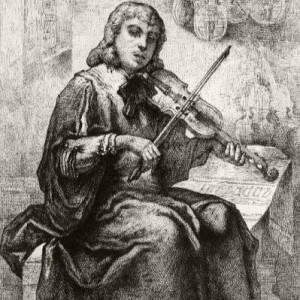
The plague epidemic that began in 1630 threw a wrench in the works. In a short time, many citizens died everywhere. Cremona was no exception. Nicolò’s parents died in quick succession during the first year of the plague. After the epidemic had passed, Nicolò struggled greatly to keep the business afloat. The consequences of the plague lingered for a long time, and most musicians were not immediately interested in expensive Amati violins. It was not until 1641 that a recovery became noticeable in Europe, and instruments were once again ordered from Nicolò Amati. He hired people from outside the family, including Andrea Guarneri.
Nicolò Amati bought a piece of land just outside the city to carry out his expansion plans, but a marauding army on a campaign destroyed everything. He had to pay off the debts incurred as a result almost until the day he died. Out of necessity, he remained in his old workshop.
Nicolò had eight children, the second of whom he named after his father: Girolamo. Girolamo was trained in Nicolò’s workshop and became his assistant around 1660. Nicolò was already sixty at the time. Nicolò Amati died at the age of 87. He had improved upon the instruments of his father and grandfather, led an iconic company, and left behind work that would remain the standard in violin making for two centuries after his death.
The fact that Cremona was by far the most important city for violin making at the time of Nicolò’s birth was due to a confluence of geographical and historical developments. The city was situated at a crossroads of borders and roads that formed a vast network connecting the Far East with the West and Northern Europe with Turkey. There was a lively trade in specialized tools, instruments, wood, oil, minerals, dyes, glues, leather, books, and precious metals. Cremona thrived on trade. But in addition, news, stories, and music from all corners of the world were exchanged there. This included knowledge about musical instruments from key regions in Europe, such as Füssen in Germany, Paris, and the Low Countries.
Nicolò’s grandfather, Andrea Amati, had made good use of this exchange of knowledge. He was probably the first, but certainly the most innovative, among the violin makers of his time. Very little is known about his work; we know even less for certain about his life. However, it is more than just a suspicion that he was the first to add a fourth string to the violin, which he had previously developed into its current form. As a result, his name had become a household name throughout Europe by the mid-sixteenth century. This fame led to him being commissioned by the French king to make 38 instruments, painted with the monarch’s coat of arms. There are indications that, toward the end of his career, Andrea Amati enjoyed the patronage of the French and Spanish courts.
Claudio Monteverdi was born in Cremona in 1567. The music of this refined composer and musician reached the courts and musical centers throughout Europe. His music was innovative, and after he wrote his first opera—which was a huge success—he put his hometown of Cremona on the map. The most important European courts were home to musical ensembles that eagerly performed his music. This demanded a high degree of virtuosity from the musicians, which could only be achieved with the finest instruments available. It is not known to what extent Monteverdi referred the musicians to the instrument makers in his hometown for those instruments, but it is certain that “Amati” from Cremona became a household name for every musician; the Amati violin had become the standard and benchmark and was copied by just about every violin maker. Thus, the Amati violin found its way to every corner of Europe.
Nicolò was born in the house where his grandfather Andrea had started out. It was a small house in the small neighborhood of St. Faustino e Giovita, where many artists and artisans also lived. It had a workshop, a store, a living area, a patio, and its own well. His father had continued to live there after his marriage, and Andrea had died there. Nicolò spent the first years of his life in that “Casa d’Amati” with an ever-growing family and a daughter from his father’s first marriage.
His grandfather, who died in 1577, had bequeathed the house and workshop to Nicolò’s father, Girolamo, and to his other son, Antonio. After ten years of working together, the two brothers went their separate ways. Antonio settled a short distance away and specialized in lutes. Girolamo continued to live there for several more years and, in 1583, purchased a substantial house with several wings and a courtyard behind the Contrada del Coltellai—a significant improvement over the house where his father had started out in 1538. (Kass)
Hargrave believes he has good reasons to argue that, in order to meet the demand for Amati’s instruments, Girolamo’s production was already so substantial by around 1590 that it provided work for about ten well-trained employees. In addition, Girolamo also sold bows, strings, and accessories. He ran a well-organized business.
After a previous marriage, Girolamo Amati married Laura de’ Medici Lazzarini, a distant relative of the de’ Medici family, in 1593. When Nicolò was born to this marriage on December 3, 1596, his father owned the most important workshop in Italy.
Nicolò started working in his father’s workshop at a young age; first, he learned the craft of violin making, but later he also learned how to manage a growing business. By the age of 20, Nicolò was ready to take on a key role in the business; Girolamo was getting on in years and had his hands full with legal matters. Nicolò was eager to expand and asked the husbands of two sisters, Vincenzo Tili and Domenico Moneghini, to join the business. By the late 1620s, they were working in some capacity in the Amati workshop, likely with the intention of becoming full-fledged business partners.
By around 1629, Nicolò had amassed a considerable fortune. He wanted to use it to expand his business, not within the city limits, but just outside them, where he had more space. To that end, he purchased a plot of land in 1630 that included a house and barns. Shortly after the purchase, however, it was overrun by groups of marauding soldiers from the 36,000-strong army that was on its way to Mantua. Undernourished and underpaid, the soldiers looted everything they could carry; the rest of Amati’s property was burned to the ground. However, he never got around to rebuilding it. The plague that broke out in 1630 threw everything into disarray.
Cremona was severely affected. In just a few days, between late October and early November, the disease claimed the lives of both of Nicolò’s parents and two of his sisters. After two years, three-quarters of Cremona’s citizens had died or fled to the countryside. Across Europe, millions of people died, with all the consequences that entailed. Musical culture largely collapsed, and virtually no one had any need for the expensive instruments from Cremona anymore. Only the wealthy European courts and the affluent nobility could still afford Amati instruments. In 1632, the French king commissioned an instrument from Amati for his orchestra, “Les Vingt-Quatre Violons du Roi.” The plague had also caused all of Nicola’s competitors in Europe to go out of business. Three years after the outbreak, Amati was the only violin maker of renown left.
The crisis, as well as his brother-in-law’s ill-advised financial transactions, caused conflicts within the family. So much so that Nicola hired mediators and lawyers. That legal battle lasted for years. Nicolò remained the owner of the company, but the costs had been high. It took nearly ten years for life to return to normal.
Archival records show that after 1640, the workshop had many live-in apprentices, including Giacomo Gennaro, Francesco Ruggeri, Andrea Guarneri, and Giovanni Battista Rogeri. There were also outside apprentices or workers, but it is not known how many there were. Nicola had no supplier. Strings, bows, tuning pegs—everything had to be made in the workshop; it was low-skilled work that was presumably done by local boys. Hargrave compared various luthiers and concluded that around 1641, Nicolò Amati ran the largest violin-making business in Italy and perhaps in the entire world. In 1645, “Casa Amati” was home to eight family members—whose composition was constantly changing—and a few servants. Nicola was famous and wealthy, but despite being 47 years old, he was not yet married.
Of all his employees known to have been apprentices, Andrea Guarneri was the most important. He proved to be more talented than the others and became Nicolò’s right-hand man. Andrea Guarneri was so closely associated with the Amatis that he was asked to serve as a witness at the wedding in 1645 between Nicolò and Lucrezia Pagliari, daughter of Giovanni Battista Pagliari. He had nine children with her.
By then, he had expanded the old Casa d’Amati with a few rooms to create a larger residence. The house now consisted of several wings with multiple living and work spaces and a large courtyard, which also had its own well. It provided shelter for Nicolò’s own family, a considerable number of relatives who lived there in varying combinations, and three or four employees who often lived with him for several years. There were also two live-in domestic helpers.
Only his second son, Girolamo, who was born in 1649, showed an interest in the craft of violin making. It is believed that Andrea Guarneri, Nicolò’s closest assistant, played an important role in the young Girolamo’s training. Amati had great confidence in him—not only as a luthier but also as a close friend. Nicolò helped arrange the marriage between Guarneri and Anna Maria Orcelli, after which they were allowed to live with him until they found a home of their own. The relationship between the two luthiers continued for many years afterward.
Among violin makers, Nicolò Amati had a reputation as an outstanding teacher. Students came to Cremona from far beyond the region’s borders and stayed with Amati for short or extended periods. Under his guidance, they built instruments, not yet under the Amati name, but “Sub Discipline Nicolai Amati, in eius officina Cremonae.” Andrea Guarneri, Francesco Ruggeri, Paolo Guarneri, and presumably the greatest of them all, Antonio Stradivari, later opened their own workshops in Cremona. Around 1670, other violin makers from outside the city had also received permission to establish themselves there.
Evidence that these students acquired their expertise from Amati is not always based on written documents. There is, however, a consensus among historians on this point. Hargrave bases his argument on the fact that there was no other violin maker in Cremona besides Amati; Hill deduces the relationship between Amati and some of his students from the construction, shape, and working methods used by Amati. And Stradivari himself noted on the labels of his first instruments that he was a student of Amati. While this is not conclusive proof (many later claimed the same), there was no other violin maker in Cremona—where Stradivari was also born—who had advanced as far in the development of the violin as Amati.
The many notarial deeds that have survived show that around 1660, Nicolò Amati not only ran a large business but also traded in musical instruments. To make this possible, Girolamo assisted him in the workshop and, as Nicolò grew older, took on an increasingly important role. By 1680, the instruments coming out of the workshop still bore Nicolò’s name, but it is likely that they were all built by Girolamo.
Nicolò Amati remained a wealthy man until the end of his life. His financial status in 1675 can be inferred from the dowry he provided for his daughter Teresa that year. It amounted to nearly four times as much as Andrea Guarneri was able to give his daughters. This was at a time when Guarneri was at the height of his fame and was certainly not without means.
Cremona had made a name for itself throughout Europe as the city where the finest stringed instruments were built. Amati’s students had struck out on their own, and Antonio Stradivari in particular—who had quickly risen to unparalleled fame—proved to be a serious competitor. Wealthy clients who had previously had their instruments built by Amati began to prefer Antonio Stradivari. Around 1680, Nicolò and Girolamo began to experience their first financial difficulties. Nicolò was unable to resolve them; four years later, in 1684, he died at the age of 87.
Nicolò Amati had provided musicians with instruments that were among the finest of his time and trained students who would carry on his legacy in the world of violin making. He is still considered one of the greatest violin makers of all time. His workshop had been the hub from which violin making could continue to develop, both in terms of place and time.
Girolamo took over his father's business, but he never reached the same level of success as his father.
The instruments that Nicolò Amati built in his early years were based on the model used by his grandfather, Andrea. His father, too, had made no significant changes to that model. The model was similar to those already being built in Brescia, Venice, and other major violin-making cities.
Around 1650, that changed; Nicolò gained increasing influence over what was made in the workshop. The work was visibly more finely finished; he introduced more elongated corners and a different design for the curves. Around 1660, these curves became shallower than on his father’s and grandfather’s violins, but to maintain the volume of the soundbox, he raised the raised edges. At the same time, he experimented with the thickness ratio of the top. These were seemingly minor changes, but they significantly improved the sound.
In the mid-seventeenth century, views on musical aesthetics underwent a radical change. Soloists were given a prominent role; they had to be able to express emotion and, just as importantly, they had to be able to shine through a high degree of virtuosity. This required a violin with a fuller tone and greater volume that was still just as playable—or even more so—than existing instruments.
Nicolò continued his experiments with different curvatures and thicknesses of the top and back plates until, around 1665, he became the first to build such an instrument. It was a model with slightly more generous proportions. This so-called “Large Model” turned out to be the greatest leap forward in sound since his grandfather’s violin. A similar development took place in Brescia and Venice, but there the instruments became longer, whereas Nicolò’s “Large Model” was actually wider.
Until the middle of his life, the curves of most of his instruments had remained quite pronounced, and the f-holes were wide. The “Grote Patroon” was lower, had slender f-holes, and, despite its substantial width, the model had an elegant appearance. But he wasn’t done yet. Nicolò continued to experiment with varnish and further detailing until he was finished in 1675. One of the few surviving violins of this model, which he built in 1682, is generally regarded as his greatest masterpiece. The number of violins he built based on the “Grote Patroon” was small; there were probably no more than a few dozen. For the most part, he stuck to the slightly smaller size.

Violin from the collection of the Musical Instrument Fund (1643) with a finely carved back made of maple wood
Before Amati, violin makers did not build two violins that were exactly alike; they were presumably copied by eye from other instruments. Andrea Amati was one of the first to use a mold around which he could build his models over and over again. This allowed a model to remain consistent for generations. Chiesa also views the wooden inner mold as a tool that allowed Nicolò to sketch his ideas for the “Great Pattern” before building it. This method was later adopted by all violin makers in Cremona. In other Italian cities, this method did not come into use until much later.
Many violin makers of Nicolò’s time used types of wood found locally. Girolamo Amati had discovered early on that combining maple for the back and sides with fine pine for the top produced the sound they were aiming for. Nicolò was the first to use a specific type of maple that not only sounded good but also had an attractive appearance due to its lively grain. That wood did not grow in the region but came from the Dolomites and the Apennines. In addition, he cut it from the log in a different way than his father had, giving it a more pronounced grain pattern.
Nicolò Amati had reached a level of craftsmanship that was unmatched in his time. Only Antonio Stradivari would later surpass this level.
The Nicolò Amati violin in the collection of the Musical Instrument Fund—purchased from its former owner, Lucy van Dael—was built in 1643. It was with this model that he conquered the world, paving the way for the development of his “Great Model.”
Hargrave R., 2009, The Amati Method, Three articles about the Amati family.
"From the Archive: a violin by Nicolò Amati, Cremona, 1660-70”, The Strad, 2018.
Powers, W., 2000, “Violin Makers: Nicolò Amati (1596–1684) and Antonio Stradivari (1644–1737).” In Heilbrunn Timeline of Art History. New York: The Metropolitan Museum of Art.
Kass P. J. The Stati D'Anime of S. Faustino in Cremona: Tracing the Amati Family 1641-1686.
Vannes, R., 1999, *Universal Dictionary of Instrument Makers*, Spa.
Chiesa, C., 2014, The life of Nicolò Amati, Cozio Archive.