Instrument

violin
Michelangelo Bergonzi
Cremona,
± 1750
played by
Maria Milstein
Maria Milstein

*1722 , Cremona †1758 , Cremona
Michel Angelo Bergonzi was born in Cremona, where four great families of violin makers—the Amatis, Ruggeris, Guarneris, and Stradivaris—were undoubtedly the most important. His father, Carlo Bergonzi (1683–1747), was also a violin maker. Chiesa and Rosengard (2010) have shown that Vincenzo Ruggeri must have been Carlo’s first teacher before he went to work for Stradivari and continued his apprenticeship with him. This conclusion is supported by archival documents that point to close personal and financial ties between the Bergonzi and Ruggeri families.
After his initial stint with Ruggeri, Carlo set out on his own, taking on Michelangelo—who must have been about twelve years old at the time—as an apprentice. Dilworth (2019) already recognizes the hand of the fifteen-year-old Michelangelo in the Bergonzi instruments he analyzed in depth. Carlo’s work was certainly, especially in the beginning, heavily influenced by that of Stradivari, and he was therefore the most likely candidate to succeed Stradivari in his enterprise, which could have led him to rise to the top of the Cremonese hierarchy of violin makers. Unfortunately, Carlo lived only two years longer than Stradivari, and it was not until later that Michelangelo added the name Bergonzi to the list of the “Four Greats.”
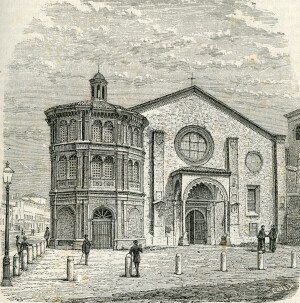
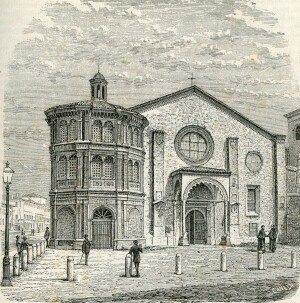
Church of San Luca, Cremona, by Francesco Canedi. Carlo Bergonzi was an active member of this parish, and Vincenzo Ruggeri also lived in this neighborhood.
After Stradivari died in 1737, his son Omobono died in 1742, and his other son Francesco in 1743, Carlo Bergonzi, along with his wife, Michel Angelo, and his brother Zosimo (1724–1779), moved into Stradivari’s house and workshop. There, the Bergonzis found a number of Stradivari’s instruments that had been left behind and were unfinished. The Bergonzis completed these instruments during their first year there. Stradivari’s sons Paolo and Giuseppe continued to live there until 1746, but after they, too, had left, Carlo rented the entire house. Michelangelo’s first son, Nicolò (ca. 1740–ca. 1782), was born there, and five years later, his second son, Zosimo (ca. 1745–1777). The year of birth of his third son, Benedetto, is unknown.
Michelangelo brought together the perfectionism of Amati and Stradivari with the improvisational freedom of Guarneri

Michel Angelo Bergonzi's double bass. Image courtesy of the Museo della Musica, Veneto
A few doors down from the Bergonzis stood the house and workshop of Guarneri del Gesù, and a little further on, that of Vincenzo Ruggeri. Michelangelo was drawn to the freer and more improvised work of Guarneri del Gesù, while his father was drawn to the more formal styles of Ruggeri.
When Carlo died in 1747, Michel Angelo continued to live and work alone at Casa Stradivari. He used Stradivari’s tools to build his own instruments, just as his father had done. Because he allowed himself greater freedom than Carlo had, his work was long and unjustly considered inferior to that of his father.
Michelangelo died in 1758. He had brought together the two most important schools of thought in Cremona: the perfectionism of Amati and Stradivari, and the improvisational freedom of Guarneri.
Michelangelo adopted two different models for his violins: one large model, based on the largest Stradivari “B” shape, and a smaller one, derived from his father’s design. In both types, he imbued them with a distinctive individuality that sets them apart from others, even if they later lack artistic merit. His cellos are particularly sought after and are renowned for their superb quality, the power of their sound, and their fine craftsmanship.
The fact that Michel Angelo built a violin in 1744 that, until recently, was identified as a Del Gesù suggests a close relationship between him and this luthier. It is a stylistic similarity to Del Gesù that Michel Angelo would maintain for most of his career.
Around 1750, Michel Angelo himself developed a number of consistent stylistic and aesthetic principles. He contrasts the relatively tall, rounded shape of his top with the low, flattened design of the later Del Gesù. The f-holes in his early work represent a fusion of Guarneri’s and his father’s styles; they are steeply curved and widely cut.
Michelangelo used wood from the native Italian maple. It had a denser grain but was less figured than the imported wood typically associated with instruments from the period between 1710 and 1720. It was inexpensive but, due to its natural density, no less acoustically superior. Material costs played a role, especially during the period when Cremona was experiencing economic hardship. At least one Michel Angelo Bergonzi violin is known to have a back made of beech. However, he made no concessions whatsoever regarding the quality of the top.
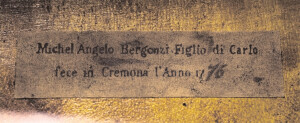
Label: Michel Angelo Bergonzi. Image courtesy of the Museo della Musica, Veneto.
At first, his varnish closely resembled that of Stradivari, but later he opted for a varnish that was more common in Venice, which was once again emerging as a center of violin making. It was a thick varnish, rich in pigment and made from soft oils. The violin by Michel Angelo Bergonzi in the collection of the Musical Instrument Fund was built by him around 1750, but forty years later his nephew Carlo (II) Bergonzi (1758–1838) replaced its top with a new one.
As the last violin maker of the Bergonzi family, Carlo (II) Antonio Lorenzo inherited the family business in 1804 from his father Zosimo (ca. 1725–1777), the brother of Michelangelo. Carlo II built a large number of instruments himself, but halfway through his career he devoted himself to restoring master instruments. Cozio di Salabue (1755–1840) wrote of him in 1816 that he was one of the best of his time in this field. Carlo’s own violins and violas are extremely rare. His earliest known instrument dates from 1780.
Reuning, Ch., 2010, Carlo Bergonzi: Discovering a Great Master, Cremona.
Rosengard D., 2010, Carlo Bergonzi and his son, Cremona.
Reuning C. H., 2007, Antonio Stradivari Violin Makers' Consortium, Cremona.
Brandon Frazier, 2007, Count Cozio di Salabue, Memoirs of a Violin Collector.
Gindin D. en Rosengard D., 2002, The Late Cremonese Violin Makers , Cremona.
Dilworth J., The Strad, vol. juni 1995, Cremonese Mistery Man.