Instrument

grand piano
J.B. Streicher (company)
Vienna,
1874
played by
Koninklijk Conservatorium
Koninklijk Conservatorium

*1792 , Wenen †1896 , Wenen

Johann Stein remained preoccupied with the playability of his instruments; he also improved the action mechanism of his fortepianos. To promote this, Stein and his daughter traveled to Vienna in 1777. There, at least 60 innovative piano builders were vying for the attention of composers and pianists such as Joseph Haydn, the young Ludwig van Beethoven, and Johann Nepomuk Hummel. Stein’s invention became known as the “Viennese” action.
“Nannette,” as Anna Maria was called, was the sixth child of the Stein family and grew up in a musical environment surrounded by piano builders and musicians. At the age of 7, she gave a public piano concert in Vienna that attracted a great deal of attention. At age 10, she tuned pianos at her father’s factory and tested her innovations on the pianos her father built.
In 1777, Mozart visited Augsburg again, this time to see yet another new innovation in Johann Andreas Stein’s pianos. Mozart had tried out the piano and had been very impressed with it. During that visit, 8-year-old Nannette played the piano for him. In a letter to his father Leopold, Mozart remarked that he believed Nannette had a great future ahead of her. Mozart was referring to her as a pianist, but Nannette went on to become one of Vienna’s most influential piano builders.

Friedrich Schiller on the Run with His Friend Johann Andreas Streicher, by Max Stieler, ca. 1850
Johann Andreas Streicher grew up in a poor working-class family in Stuttgart. His father died when he was only 8, after which he lived in a children’s home until he was 16. Despite these difficult circumstances, he taught himself to become a gifted musician who found his way into the circles of the court musicians. There he met the writer Friedrich Schiller, and a friendship developed between the two. In 1782, the poet and playwright came into conflict with the Duke of Württemberg. Johann Andreas Streicher helped him escape imprisonment. He used the money intended for a trip to Hamburg to study with Carl Philipp Emanuel Bach, but instead secretly fled across the border with Schiller. Johann Andreas Streicher then became a traveling musician and, instead of going to Hamburg, went to Augsburg in 1786 to visit Johann Andreas Stein, where he met his future wife, Nannette.
These two encounters, which were important to Nannette, were followed by a third. And just like those with Mozart and Streicher, this one also played a decisive role in shaping her life and work as a piano maker. In 1787, Ludwig von Beethoven visited the Steins’ workshop in Augsburg in search of an instrument suited to his powerful touch. That marked the beginning of a lifelong friendship between Beethoven and Nannette. She remained Beethoven’s rock and support throughout her life. Beethoven wrote her more than 60 letters that attest to their deep and warm friendship.
In 1792, Nannette’s father passed away. At just 23 years old, she and her brother Matthäus took over their father’s business. They named the factory “Frère et Sœur Stein.” In 1794, Nannette married Johann Andreas Stein. They moved to Vienna, and Matthäus went with them. There, they received permission to open a new factory, which built pianos under the name “Frère et Sœur Stein d’Augsbourg à Vienne” until 1802.
In 1802, Matthäus changed his name to André and started his own business, also in Vienna. Nannette and Johann Andreas continued together. Johann Andreas’s focus shifted from performing in concerts to giving piano lessons, composing, and organizing music salons. The business came under Nannette’s leadership and was named “Nannette Streicher née Stein,” which was highly unusual for a woman at the time. This marked the beginning of the actual history of the Streicher firm.
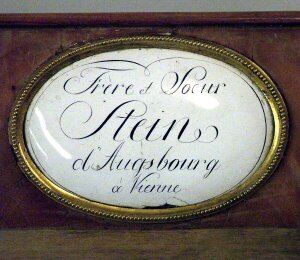
Nameplate in a fortepiano from the collection of The Met, New York
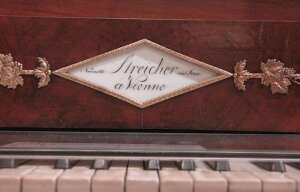
Nameplate for the company Nannette Streicher (née Stein)
Johann Baptist was born in 1796 to Nannette and Johann Andreas. Soon after his birth, his parents became active in the Viennese music scene, which often took place in salons. These Viennese salons were the premier gathering places for writers, scientists, and musicians. It was often the wealthy, intellectual women who organized cultural evenings in their own homes, sometimes on a weekly basis.
Nannette and Andreas also organized a similar music salon. At first, they performed there themselves, and later they began inviting other musicians as well. In 1812, they moved these gatherings from their home to a 300-seat concert hall that they had built on the grounds of their piano factory. The hall opened with a highly publicized concert attended by many distinguished guests from Vienna. This initiative would later give rise, later that year, to the Wiener Musikverein . Clara and Robert Schumann, Johannes Brahms, Franz Liszt, and Frédéric Chopin performed in this Streicher Hall.
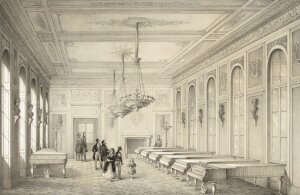
Streicher Hall, circa 1840
The Streicher company was initially, by and large, conservative in its approach to technology, while major piano makers such as Erard and Pleyel were rapidly introducing innovations into their fortepianos. And that was precisely what appealed to Beethoven. In October 1803, he was sent an Erard piano. It was Beethoven’s first piano made abroad. He was “so enchanted by it that he considered all the pianos made here [in Vienna] to be rubbish in comparison.” A remark he would retract after meeting Streicher. The sound of the French piano may have been good, but the touch was much heavier than that of the Viennese pianos.
Between 1775 and 1850, there was virtually no successful piano builder who did not have a number of innovations or patents to his name. In an effort to win musicians over to their instrument, these innovations were widely publicized. Erard had over thirty, and Pleyel nearly fifty. It is estimated that 80 percent of all innovations were adopted by other companies—with minor modifications to the design—in the grand pianos they built thereafter. The Streicher family held five patents.
In 1792, France declared war on Austria, a conflict that was not formally ended until 1809. It had completely depleted the Viennese treasury. This led to inflation, poverty, and food shortages in the city. Pianos were hardly being sold there anymore. Through a widespread network of spies, strict censorship was imposed on the citizens to suppress liberal and nationalist ideas such as those propagated by the French Revolution. Composers reacted immediately to the war. Beethoven wrote his Eroica (originally for Napoleon) and later Wellington’s Victory to celebrate the victory over the French. Because large public gatherings were viewed with suspicion, musical life increasingly shifted to private salons. The piano evolved from an instrument of the elite into a status symbol for the common bourgeoisie.
In 1817, Beethoven went through a turbulent period. While Nannette managed the piano factory, she took charge of Beethoven’s schedule and household for a year and a half, allowing him to focus on composing. He confided in her about his deteriorating health, declining hearing, and melancholy. He corresponded with Andreas about the latest innovations in Streicher pianos. The moral and practical support he received from the Streichers helped Beethoven get through a very difficult period.

Johann Baptist Streicher, lithograph by Adolf Dauthage, 1862
Their son, Johann Baptist, grew up among these great names in music and within this vibrant musical community. His social skills and understanding of what musicians and composers needed developed within this circle, and he applied this knowledge to the construction and sale of pianos.
Until he was sixteen, Johann Baptist attended the highly organized school system in Vienna, and after that he began working in his parents’ workshop. There he learned both the technical and artistic aspects of Viennese piano making.
During this period, they delivered the first piano to Ludwig von Beethoven. They had adjusted the action to accommodate his forceful touch and the sound to account for his incipient deafness. He kept this instrument until his death
The rapid developments in fortepiano construction in France and England made it necessary to look beyond Austria as well. From 1821 until the end of 1822, his parents sent him on a study trip to visit the most prominent piano builders of the time: Sébastien Erard in Paris and John Broadwood & Sons in London. Upon his return, he became a co-owner of the company, which was renamed “Nannette Streicher & Sohn.”
During this period, they delivered the first piano to Ludwig von Beethoven. They had adjusted the action to accommodate his forceful touch and the sound to account for his incipient deafness. He kept this instrument until his death. After Beethoven, Goethe purchased a Streicher, and it became the piano on which Felix Mendelssohn played. Liszt always declared himself a great admirer of Erard, but on his concert tours of 1838 and 1839 to Bologna and Florence, he nevertheless preferred a Streicher.
‘The fortepiano should meet the player halfway;the instrument should not force the player to labor,but rather respond with the greatest elasticity to thesubtlest nuances of touch’
Starting in 1832, Nannette gradually handed over the factory to her son and stopped working. “Nannette Streicher & Sohn” employed 17 people at that time and was renamed “J.B. Streicher” after the takeover. Nannette and Johann Andreas died four months apart in 1833. Shortly before that, Johann Andreas had written a book that would become one of the most comprehensive sources on Schiller’s flight and literary breakthrough. It was his second book; he had written his first as early as 1803 on playing the fortepiano; after all, he had numerous compositions for this instrument to his credit and had compiled a songbook for Protestant churches.

Beethoven's Study, Johann Nepomuk Hoechle, 1827
Nannette’s friendship with Beethoven also remained of great importance to Johann Baptist. At his concerts and in private, Beethoven often used a Streicher grand piano that had been customized to his specifications. Beethoven regularly asked them to make improvements to his instrument. It was important for the company to meet his demands, as Beethoven gave Streicher pianos a prominent place in Viennese musical circles. His relationship with Johann Baptist was so good that he asked Johann Baptist to accompany him on a trip to England, where he could introduce him to his English connections. Due to Beethoven’s deteriorating health, the trip was canceled.
Two years later, Johann Baptist married the daughter of the Viennese publisher and composer Auguste André, and they had three children together, including their youngest son, Emil, born in 1836. She died in 1847 at the age of 45. Emil was only 11 years old and was taken in by the family; he then began working at the factory when he turned 18.
After the death of his parents, Johann Baptist became the sole owner of the business on Ungargasse, which from that point on was called “Johann Baptist Streicher.” In 1849, he married the pianist Friederike Müller (1816–1895), with whom he had one daughter. Johann Baptist had five children, of whom only Emil remained in the business.
Unlike large companies such as Erard and Pleyel, which sold about 5,000 pianos a year (…), Streicher, with 17 employees, focused on high-quality grand pianos for Europe’s finest musicians, producing only about 150 per year
Between 1800 and 1850, the popularity of the fortepiano skyrocketed. In 1850, there were 200 piano builders in Paris and about 180 in London. In the much smaller city of Vienna, the number had grown to about 150 builders between 1800 and 1850. In the years that followed, most of those who had not specialized or who had no international ambitions disappeared from the scene.
Unlike large firms such as Erard and Pleyel—each of which employed more than 200 people, sold about 5,000 pianos a year, and devoted themselves to technical innovations— Streicher, with just 17 employees, focused on high-quality grand pianos for Europe’s finest musicians, producing only about 150 per year.
To stand out among the hundreds of domestic and foreign piano builders, every builder who could afford it took part in one or more major events. For Streicher, the 1851 World’s Fair in London was his first such event. Millions of people flocked to the Crystal Palace in Hyde Park, which had been built specifically for the occasion. There, Streicher won a gold medal for a concert grand piano. The Erard company won the Council Medal.
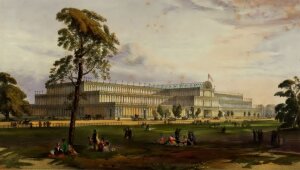
1851 London World's Fair
With attendance figures ranging from 11 to 15 million, the 1867 Paris World’s Fair marked the absolute peak of the empire under Napoleon. At this fourth World’s Fair, Pleyel and Erard were on a comparable level, but to everyone’s surprise, Streicher won the gold medal.
In 1857, Emil became a partner in his father’s factory. Two years later, in 1859, the company name was officially changed to “J.B. Streicher und Sohn.”
‘I received a beautiful Streichergrand piano. He wants to use it to show me hislatest achievements.’
When Johannes Brahms moved to Vienna in the early 1860s, he sought to join the Viennese musical elite in order to make a name for himself as a pianist and composer. The Streicher family’s concert salon on Ungargasse in Vienna was still a central gathering place for composers, critics, and musicians, and Streicher was one of the city’s leading piano builders.
In 1864, Johann Baptist offered Brahms a Streicher piano, and in October of that year, he wrote excitedly to Clara Schumann: “I have received a magnificent grand piano from Streicher. He wants to show me his latest achievements with it, and I think you would be pleased with it as well.” He appreciated the piano’s action, which was neither “Viennese” nor “English” but exhibited characteristics of both types: velvety soft, yet powerful enough for his compositions. Brahms received a second Streicher piano in 1872 from Emil—grand piano No. 6713. An instrument that would become his property a year later and that he would continue to play until his death. It was a successful model, of which Streicher would build several between 1868 and 1874.

Composition by Theodor Streicher
Johann Baptist Streicher transferred the business to Emil in 1871, shortly before he passed away a few months later at the age of 75. Johann Baptist Streicher was buried in Vienna. He had become a Hof-Klaviermacher in 1839 and was knighted in the Order of Emperor Franz Joseph in 1863.
Under Emil Streicher, the company—with a few dozen furniture makers and technicians—still produced about 170–200 grand pianos per year. Emil resisted expansion and industrialization. He held fast to the family tradition of high-quality craftsmanship at a time when the market was rapidly industrializing and massive factories were building thousands of pianos a year. Steinway and Bösendorfer dominated the market. Although Emil led the company for 25 years, there were hardly any innovations, and the number of instruments built annually remained at a level comparable to when he took over the factory.
Emil retired in 1896. His son Theodor was a composer and had no ambition to take over the company. In 1897, Emil liquidated the company. The remaining assets and workshops were sold to the Viennese piano makers Stingl. Emil died in 1918. The name Streicher retained its almost iconic status until the very end, and a street in Vienna was even named after the family.
Streicher pianos occupy a place between the classical fortepiano and the Romantic grand piano. While making all the adjustments necessary to adapt the instrument to changing musical styles, the Streichers preserved the rich Viennese tone and the rapid repeated notes. Ultimately, thousands of pianos were built, some of which were so significant that countless replicas have been made.

Streicher's patent on a mechanism with a hammer striking from above rather than from below, 1823
Two patents held by Streicher were of great importance. First, there was a patent for the hammerklavier, in which the hammers struck the strings from above; but the most important patent was for a system in which a struck string caused another string—one that was exactly an octave higher—to vibrate as well. What Johann Baptist did not patent may have been the most important innovation: he is credited with inventing the soundboard as it is used in modern pianos.
Thanks to its refined tone, the Streicher remained popular over the years, especially among string players who used gut strings. A Streicher would never overpower the violin.
De Silva P., 2008, The Fortepiano Writings of Streicher, Londen
Fuller R. A., 1984, Andreas Streicher’s notes on the fortepiano, Wenen
Goebl-Streicher, U., 1999, The Stein-Streicher Family of Piano Builders, Bonn
Ladenburger, M., 1999, Beethoven and the Streicher Family, Bonn
Latcham M., 2007, The development of the Streicher firm of piano builders under the leadership of Nannette Streicher, 1792 to 1823, Tutzing
Latcham M., 1998, Mozart and the Pianos of Johann Andreas Stein, Londen
Harding R.E.M., 1978, The Piano-Forte: its history traced to the Great Industrial Exhibition of 1851, Surrey
Janmaat, F., 2019. Sébastien Erard, the Greatest Harp and Piano Maker of All Time, Enkhuizen
Melville, D.,1971, Beethoven’s pianos: The Beethoven Companion, London
Weitzmann, K. F., 1897, History of pianoforte-playing and pianoforte-literature, New York
Hardy T., 2001, Wilhelm Cramer, London/New York