Instrument

violin bow
Jean Pierre Marie Persoit
Paris,
±1850
played by
Ionel Manciu
Ionel Manciu

*1785 , Parijs †na 1866 , Villers-Cotterêt
In the early nineteenth century, Paris was the center of French musical culture; many violin makers made their living there, provided they could adapt to the ever-changing musical fashions. Jean Pierre Marie Persoit, born in the heart of Paris, managed to do so with varying degrees of success.
His father, Pierre Persoit, sold fruits and vegetables. Although his mother helped out, they lived in relative poverty. Jean Pierre did not follow in his father’s footsteps, but instead learned the trade of goldsmith and engraver, a profession that offered the prospect of a more prosperous life. It is believed that, in addition to decorative work in precious metals, Jean Pierre also crafted the silver and gold parts for bow tips. Due to strict Parisian guild regulations of the time, violin makers were forbidden from making these parts themselves but were required to have them made by a member of the silversmiths’ and goldsmiths’ guild. This custom persisted even after the power of the guilds had waned. Just as the young François Xavier Tourte had traded his profession as a clockmaker for that of a violin maker, Jean Pierre Persoit resolved to change careers and follow the same path.
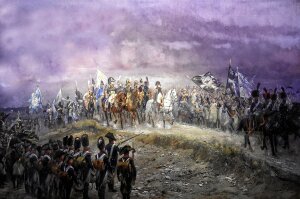
The Evening of the Battle of Jena, October 14, 1806 · Jean-Baptiste Edouard Detaille
Jean Pierre was forced to postpone that plan for more than three years. In 1804, he was called up to serve in Napoleon’s army. For his courageous actions during one of the campaigns, he was promoted and had to lead his regiment on the front lines. However, during the Battle of Jena in Prussia in 1806, he was so seriously wounded that it took him several months to recover. After being promoted to captain in 1807, Jean Pierre Persoit remained in Napoleon’s service until the end of that year. Due to his absence from Paris, little remained of his clientele, so he sought out a mentor to become a violin maker.

Nicolas Lupot
Leading researchers such as Millant, Raffin, and Childs have found sufficient evidence to conclude that Lupot was Persoit’s teacher. Father Lupot and his son Nicolas had established themselves as independent violin makers in Paris in 1794. Shortly after settling in the capital, they had already gained great renown for their fine instruments, built in the Italian style, and their exceptional bows. Jean Pierre Persoit could not have found a better place to learn his craft.
In the Paris archives, Persoit is not yet listed as a violin maker in 1812, but he is listed as an “assistant violin maker”; it is not known who that person was. However, he did marry Jeanne Faverot that year; they already had a daughter together who had been born three years earlier.
He opened his first workshop just behind Les Halles, which was then under construction and was set to become the center of commerce. François Xavier Tourte also had a studio nearby. Over the next fifteen years, Jean Pierre moved four more times, always within the same neighborhood and always near Tourte. It may be a coincidence, but that seems unlikely; Persoit’s work resembles Tourte’s too closely for that.
Persoit was influenced not only by François Tourte, but also by the unconventional and experienced Jacob Eury.
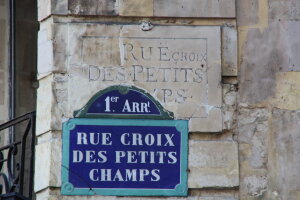
Childs points out that Persoit was influenced not only by the much older François Tourte, but also by the unconventional and experienced Jacob Eury (1765–1848). This violin maker, who had specialized in making bows, had moved to Rue Croix-des-Petits-Champs in the same year that Persoit opened his first workshop. He set up shop just a few houses away from the building where Nicolas Lupot had his workshop.
Eury was deeply in debt and had taken out a loan from the violin maker Jean Gabriel Koliker. Koliker was also located on Rue Croix-des-Petits-Champs and owned several other properties on that street. Jacob Eury was allowed to move his workshop into one of them. Eury undoubtedly worked for Koliker as well, but despite everything, he remained true to his own artistic vision and continued to craft exceptionally distinctive bows that appear to be strongly influenced by Tourte. This is not surprising, as neighbors, they undoubtedly exchanged experiences. For Persoit, Rue Croix-des-Petits-Champs became a meeting place for violin makers and bow makers who were important to him.
Hyperinflation had ruined many violin makers; only the most innovative Parisian makers survived.
As a self-employed craftsman, Persoit was not very successful; this is not surprising, since political upheaval had brought France, in succession, the Enlightenment, the Modern Era, Napoleon, and—after his fall—Louis XVIII, all of whom had brought about changes in musical culture. And each change, in turn, placed different demands on violin makers and bow makers. Ultimately, it was hyperinflation that had dealt the final blow to many violin makers. Only the most innovative Parisian makers, such as Jean-Baptiste Vuillaume, survived. Many other makers sourced their bows from Mirecourt, where competition was so fierce that even very good bows were sold by the dozen for a small sum.

J.B. Vuillaume
With a family that now included four daughters, Jean Pierre Persoit closed his unprofitable workshop in 1826 and went to work for Vuillaume—a remarkable move, since other instrument makers had previously worked only for him. Vuillaume had just married Adèle Geneset, the eldest daughter of the wealthy entrepreneur and mayor of Clermont. She was devoted, intelligent, and very wealthy. Together, they had purchased a workshop and residence on Rue Croix-des-Petits-Champs in Paris. It was a large property in a lively neighborhood, with well-known violin makers and bow makers as neighbors. Their workshop flourished amid the dozens of Parisian violin-making workshops and stringed instrument dealers, many of whom, however, were barely able to stay afloat.
At Vuillaume, Persoit began as a violin maker, but Vuillaume soon recognized Persoit’s talent as a bow maker and had him craft his first experimental bows. Vuillaume’s business was so successful that in 1828 he expanded by opening a new workshop where he had his most talented employees focus exclusively on making bows.
At the same time as Persoit, the young, brilliant Dominique Peccatte had come to work there in 1826. Peccatte was an inexperienced young man who was too restless to build violins, but who had a good eye for bows. Vuillaume had Persoit take him under his wing. Dominique Peccatte proved so promising that Jean Pierre Vuillaume persuaded the authorities to buy him out of military service, for which he had been drafted. At Vuillaume’s, nothing came for free, and he required Peccatte to remain in his service for six years for a very modest salary. Eventually, he was promoted to chief assistant, responsible for the production of Vuillaume’s self-sustaining and metal bows. Peccatte and Persoit worked closely together at Vuillaume throughout those years. Peccatte left after just six years to join François Lupot, but Persoit continued to work at Vuillaume until 1838.
The following year, Jean Pierre Persoit tried again, and this time with greater success. He opened his own workshop once more, made bows under his own name, and also made them for others.
During Persoit’s lifetime, music had gradually regained an important social role; many new compositions were being written, and concerts drew massive crowds. As a result, the musical scene in Paris flourished tremendously. Many musicians flocked to Paris, which had remained the center of art and culture throughout it all. The conservatory, too, flourished once more. It is no surprise that the demand for new instruments increased. Even small workshops had enough work or even expanded. Jean Pierre Persoit worked as an independent bow maker in Paris for over twelve years. His wife died in 1849. Persoit continued his business for a few more years, moved to the outskirts of the city two years after her death, and after 1854, he can no longer be found in the Parisian archives.
Jean Pierre Marie Persoit ranks among the great 19th-century French bow makers.

François Xavier Tourte
When Jean Pierre was starting his career, it was common for violin makers to regard bows as a mere accessory to their actual violin-making work. Bows were a secondary matter. Consequently, the design of bows varied according to the violin maker’s preferences, prevailing trends, and the demands of musicians. The distinct craft of bow making did not emerge until around 1800, when François Xavier Tourte first devoted himself to making bows. In the years that followed, others also began to take an interest in the craft. Tourte’s innovations made an enormous contribution to the development of the bow as we know it today, but it would still take years before a balanced, generally accepted design emerged.
Persoit's bows reflect the influence of Lupot, as well as that of Tourte and Eury
Jean Pierre Persoit’s early bows resemble one another, but also exhibit significant differences. Researchers believe that Persoit crafted them freehand, without first making a drawing or design, as became customary later on. He refined the shape, balance, and thickness of the stick during the crafting process until the desired bow was achieved. If he had created a good model, he would more or less copy it. He drew heavily on Lupot’s work, but his bows also reveal the influence of Tourte and Eury.
The bows he made at J.B. Vuillaume sometimes, but not always, bear Persoit’s initials. However, his influence is always clearly evident. Vuillaume was curious, innovative, and experimented a great deal. He often had his employees carry out his new ideas. One such example was bows that could be rehaired in a simple—and therefore inexpensive—way. It is known that Persoit worked on these innovations.
Even though Persoit’s later bows differ from one another, they share a sense of elegance and a certain lightness. He begins shaping his bows with an octagonal cross-section and only gives them a round cross-section shortly before the center.
A characteristic feature of Persoit’s work is that he adhered to an earlier practice of not using a silver band between the socket and the shaft.
After leaving Vuillaume, he continued to model his bows largely after those of his former employer as a tribute. Later, his bows became more powerful, and he used slightly lower and longer frogs than other makers. It was likely his frugal nature that led him not to have his own brand mark made, but instead to file away the “A”s and the “I” from an existing stamp bearing the text “A PARIS,” leaving the initials of his last name, P R S. He branded these letters onto the rod near the socket and sometimes onto the socket itself, but never on the side, as was customary.
Persoit did not produce a large body of work. Today, his bows are rare, usually exquisitely crafted, and very valuable.
Thoene J., 2006, Violins & Bows, London.
Childs P., 2003, Jean Pierre Persoit, His life and his work, New York.
Gaudfroy, B., 2001, “La Naissance de ‘l Archet Moderne,” Paris.
Raffin, Jean-François; Millant, Bernard, 2000, *L’Archet*. Paris: L’Archet Éditions.
Cité de la Musique/Musée de la Musique, Violins, Vuillaume, a 19th-Century French Master Luthier, 1998, Paris.
Liivoja-Lorius J., ’The Bows of Persoit’, The Strad, xci (1980–81), 254–6.
Millant, R., 1979, J.B. Vuillaume: His Life and Work. Hill & Sons, London.
Vatelot, Étienne, 1976, *Les Archet Francais*. Sernor: M. Dufour.
Henley W., 1969, Universal Dictionary of Violin & Bow Makers. Brighton.
Roda, J. 1959. Bows for Musical Instruments, Chicago.
Tarisio; the Cozio archives, accessed in 2019.
Géneanet, accessed in 2019.
Archives Nationales de France, accessed in 2019.


