Instrument

violin
Giuseppe Guarneri “del Gesù”
Cremona,
± 1736
played by
Vadim Tsibulevsky
Vadim Tsibulevsky

*1698 , Cremona †1744 , Cremona
Bartolomeo Giuseppe was the youngest son of the violin maker Giuseppe Giovanni Battista Guarneri of Cremona, better known as Giuseppe Guarneri “filius Andreæ.” In Italy, it was unusual to name a son after his father. This led to long-standing speculation as to whether Giuseppe was an adopted son or an illegitimate child. To distinguish him from his father, “del Gesù” was added to his name posthumously. It is derived from the three letters IHS that Giuseppe had printed on his label, which stand for “Iesus Hominum Salvator,” Jesus, Savior of Mankind.
‘If Stradivari is the poet of the violin,then Guarneri del Gesùis its philosopher’
Among the brilliant instrument makers in Cremona, such as Stradivari and Amati, the Guarneri family hardly stood out; they were not wealthy, produced very few instruments, and their reputation extended little beyond the city of Cremona. Their instruments were not included in any collection from that period. Until the mid-nineteenth century, they were even referred to as “second-rate” by one of the foremost authorities on Italian violin making, Count Cozio de Salabue. It was not until Paganini toured Europe in 1828, performing concerts with one of Guarneri del Gesù’s instruments, that the genius of this luthier became apparent. The sound of his instruments won over even the most critical Viennese audiences and was virtually unmatched by other instruments. Since then, his genius has been widely recognized, demand for his instruments has grown, and their prices have skyrocketed.

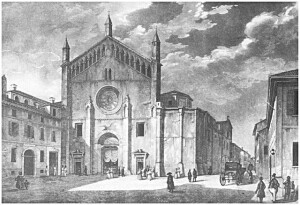
Basilica of St. Dominic, Cremona
Bartolomeo Giuseppe Guarneri was born in 1698 at the Casa Orcelli-Guarneri, a simple but large house in the center of Cremona where his father and grandfather also had their workshops and which his father had already named “Sub Sanctae Teresia.” It was conveniently located on Piazza San Domenico, in the shadow of the church of the same name.
Giuseppe was the youngest son of Giuseppe Joseph Guarneri—who called himself Guarneri “Filius Andreae”—and Anna Maria Orcelli, with whom he had six children. A year after their marriage, their first child was born, but she died just a few days later. Their other two daughters also met the same early death.
Pietro had been born three years before Giuseppe and had survived. On the day Giuseppe was born, in addition to the female members of the family, five violin makers from the Guarneri family were living under the same roof: grandfather Andrea, his son Pietro (“of Mantua”), Giuseppe (“filius Andreae”), and his grandson, Pietro (“of Venice”).
The Guarneri family was certainly not wealthy; Giuseppe's father had to take out a loan to buy the house
Marquis Giovanni Battista Ariberti, patron of Cremona’s only theater, was Giuseppe’s godfather. Barely three months after Giuseppe’s birth, his grandfather Andrea Guarneri passed away.
Joseph Guarneri “Filius Andreae” had worked for Nicolò Amati until a few years before his marriage. His marriage had expanded his network of influential contacts in Cremona, but he had not received many commissions from them. The Guarneri family was certainly not wealthy; Giuseppe’s father had had to take out a loan to purchase the house and had to rent out part of it. To cover the costs of his growing household, Giuseppe “Filius Andreae” worked as a violinist.
Giuseppe and his brother Pietro were trained by their father to become violin makers over the course of about eight years. And because playing the instruments was part of their training, they were also taught how to play them. Early in Giuseppe’s career, competition among Cremona’s violin makers intensified. Girolamo Amati II, the son of Nicolò Amati, had returned to work with his father and was producing a large volume of instruments. But even more significant was the rise of Antonio Stradivari. Thanks to his success, he was able to move to Piazza San Domenico in 1680, bringing him just a few meters away from the “Casa Guarneri.” The Stradivari and Amati families often had apprentices and employees living in their homes or nearby; as far as we know, the Guarneris worked alone.
‘The Stradivari and Amati families often hadstudents and employees living in their homes or nearby,while, as far as we know, the Guarneris worked alone’
At that time, only four families were active in violin making in Cremona: the Amatis, the Rugeris, the Stradivaris, and the Guarneris. In Cremona’s rather strict hierarchy, Stradivari quickly rose to become the foremost. However, the most influential was Amati, whose model the others followed.
Del Gesù’s father, Giuseppe “filius Andreae,” was a skilled craftsman, but his instruments could not compete with those of his great contemporaries. The wood he used was simple—sometimes beech, poplar, or linden—and not always cut in the same way. While they met the musical demands of his time, they did not rise above them. Compared to the instruments of his great fellow townspeople, his instruments were affordable, costing only one-fifth of the price Stradivari charged.
Pietro and Giuseppe worked together in the family workshop under their father’s guidance until Pietro left his parents’ home in 1719 to work elsewhere in Cremona, leaving Giuseppe and his father behind. That was a remarkable and risky decision for that time; never before had a son in Cremona left his father’s business at that age. Competing with his father and brother, Pietro built his instruments in Cremona for several years before moving to Venice around 1721.
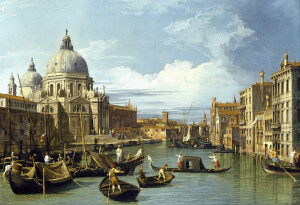
The Entrance to the Grand Canal, Venice, by Giovanni Antonio Canal (Canaletto), ca. 1730
It is almost certain that the two brothers continued to meet later on, but given the differences between the instruments they built, there was no more than a modest degree of collaboration or mutual influence. Cremona was nothing more than a provincial town, while Venice was a metropolis. It was the musical center of Italy. Musical innovations often originated there. Venice, where Vivaldi raised the city’s musical standards to new heights, was an important source of trends and influences for all violin makers.
Pietro’s departure was likely prompted by the decline in demand for instruments still based on the old Amati model, but also because the Guarneri family was gradually being overshadowed by the rise of the far more successful Stradivari. Stradivari was innovative, had a large production output, and built instruments primarily for the more affluent. Moreover, Cremona began to lose its dominance in violin making due to the emergence of new centers both within and outside Italy. As an additional reason, Hill (1989) notes that the differences of opinion between Pietro and his father, with whom he lived under the same roof, had become too great for them to remain together any longer.
After Pietro’s departure, father and son Giuseppe “del Gesù” adapted their style somewhat to that of Stradivari, but despite this, demand for Guarneri’s instruments virtually dried up starting in 1720. Father and son continued to build for another two years until Giuseppe married in 1722 and moved out of the family home. His wife was Katarina Rota, a Viennese woman who had presumably been left behind in the Po Valley in the wake of the Austrian army. They had no children.
It is generally believed that Giuseppe “del Gesù” was touring as a violinist during that period (…)
It is not known what Giuseppe did during the first four years after his marriage (between 1722 and 1726). No instruments made by him have been found from those intervening years to suggest that he worked as a violin maker. Starting in 1720, music experienced a revival in Italy; not so much at the courts, but singing and dancing accompanied by violin music became incredibly popular among the common people. Many violin makers, often forced by financial hardship, were also the players of their own instruments. It is generally assumed that Giuseppe “del Gesù” traveled as a violinist during that period and later worked at one of the many courts in northern Italy before returning to his hometown. Even though Del Gesù traveled regularly back and forth between different cities, he built his instruments exclusively in Cremona.
It wasn't until around 1726 that instruments made by Del Gesù began to appear again. Although he no longer lived in the Casa Guarneri, his relationship with his father remained good. However, the historian François Fétis referred to violins made by Del Gesù between 1726 and 1729 that bore a label on which he stated “Joseph Guarnerius Andreae nepos,” a text indicating that he was the grandson of Andrea Guarneri. In doing so, he avoided mentioning his own father. His grandfather had enjoyed a higher status than his father, who had fallen into poverty. For a long time, the view of Hill was widely accepted, who argued that the “nepos” labels were not original; however, later research, particularly that of Dilworth and Chiesa (2015), has confirmed that they did indeed originate from Giuseppe “del Gesù.”
The family was deeply in debt, and to pay it off, they had to sell part of their house. Their situation worsened even further after Del Gesù’s mother died in 1737. To pay for her funeral, his father had to take out another loan. A more stark contrast to the man about whom the saying in Cremona went, “To be as rich as Stradivari,” was unimaginable at that time.
The revival in music had also increased the demand for instruments, but Guarneri “filius Andreae” was no longer able to meet that demand. During the last nine years of his life, until his death in 1739, Giuseppe “filius Andreae” hardly made any instruments himself. He had become entirely dependent on his son.
Northern Italy once again became the battleground where France and Austria fought out their power struggle. Thanks to the victors, the French Bourbons, Northern Italy experienced a revival. The region had proven receptive to the ideas of the Enlightenment. Music was no longer intended solely for the court but also for the common people. A new musical renaissance flourished in Venice, Milan, and Naples. A new generation of professional musicians sought a more powerful, richer sound: a straightforward instrument without the embellishments found in Stradivari’s instruments. This movement found what they were looking for in Del Gesù, a choice that suited their often meager incomes.
‘Guarneri del Gesù's violinspossess a passion and a power; they are both thedevil's and the angel'sinstrument’
Stradivari’s influence waned as he grew older, and around 1730, Giuseppe “del Gesù” saw an opportunity to make a fresh start as an independent violin maker in Cremona. During that time, he was clearly influenced by makers from outside Cremona. It is possible that his brother Pietro played a role in this.
It took only a few months after he began working as an independent luthier before Giuseppe had a new label printed that no longer referred to his family. That wasn’t necessary anyway; he was now the only Guarneri violin maker in Cremona. His label became famous for the combination of the letters IHS and a cross that he had placed after his name. Why he did this has never been determined. It was not until half a century later that this earned him the nickname by which he has gone down in history as “del Gesù,” with the assumption that the letters IHS stood for Iesus Hominum Salvator.

The interior of the Guarneri del Gesù violin (photo taken during restoration in 2000) from the collection of the Musical Instrument Fund. The label bearing the letters IHS is clearly legible.
From 1726 to 1730, he seemed to experiment with every instrument he built. The curves and thicknesses of the wood shifted ever so slightly. While Stradivari had captured the attention of high society and wealthy collectors with his magnificent instruments, Del Gesù built for musicians. He focused not so much on appearance as on the sound, which, once he had perfected it around 1730, became incredibly popular among musicians.
Between 1730 and 1740, his reputation soared. For a short time, he strove for perfection, but in the years that followed, he became less concerned with the finish and more impulsive. A close examination of his instruments from that period revealed that he rarely went over the same spot twice with his tools. This period is considered his peak.
‘Del Gesù’s violins speak not to the fingers,but to the heart—they do not demand perfection,they demand passion’
What was already evident around 1730 was reinforced by the waning influence—and eventual death—of Antonio Stradivari in 1737. Until then, Stradivari had been the undisputed supervisor of the city’s violin makers and was recognized as the “conscience” of the craft. His presence ensured that the principles of violin making were upheld in everything produced in Cremona. After his death, Del Gesù seemed, in a sense, to be freed from those rigid formalities, a trend that was also evident among other Cremonese violin makers.

"Il Cannone Guarneri" (1743), on display at Palazzo Doria Tursi, Genoa
According to most estimates, there are approximately 150 instruments made by Del Gesù; this figure does not include the instruments he built alongside his father. This is a small output compared to that of Stradivari, to whom over 1,000 instruments are attributed. It should also be noted that he died young and was not a violin maker for his entire life. During his fifteen productive years, he built about ten instruments per year, almost all of them violins. As research into Del Gesù’s “signature style” progressed, two cellos were largely attributed to him. These were instruments that “filius Andreae” had begun, and of which Del Gesù completed one in 1729 and the other in 1731.
From 1740 until his death, stories continually surfaced in later years about his allegedly dissolute lifestyle, his bluntness, and even a conviction that had landed him in prison. With the help of a girl who brought him tools, he is said to have continued making violins even from behind prison walls. Hill, Dilworth, and Chiesa consider this unlikely and point out that Del Gesù signed commercial documents as a witness every year and must therefore have been regarded as trustworthy.
No researcher has yet been able to find any evidence of a conviction. Studies from 2022 have debunked that myth. Yet these stories continue to resurface time and again. They add color to Del Gesù’s short life, as there are no factual documents regarding his final years.
As far as is known, in 1743 he built only three more instruments, including “il Cannone”—the instrument with which Paganini would definitively cement Del Gesù’s fame eighty years later. He died suddenly a year later. After receiving the sacraments, he was laid to rest in the Church of S. Prospero. Giuseppe Guarneri “del Gesù” was only 47 years old. Catarina, as his wife was registered, survived him, married an Austrian soldier, and returned to Vienna. The house, workshop, and supplies were likely taken over by another Cremonese luthier.
The first violins Del Gesù built after leaving his father’s workshop were already somewhat modeled after Stradivari, but in their overall design he remained faithful to the Amati form. This design came from a mold that had been made by his grandfather Andrea and passed down to subsequent generations of violin makers in the family. Even later, this mold remained the basis for all of Del Gesù’s work. Research has shown that the various models and styles built by Del Gesù likely all originated from this single mold.
The same study revealed the extent of Del Gesù’s contribution to his father’s instruments. Given how frail “filius Andreae” had become in the 1920s, he was likely no longer able to perform the most strenuous work. Some parts of instruments bearing the “Giuseppe filius Andreae” label were made by the father, but large portions were crafted by his son, Del Gesù.
In Cremona, it was customary for a son to use his father’s label as long as he was not registered as an independent violin maker. The number of instruments that Del Gesù built with his father under his father’s label is conservatively estimated at 50.
[Giuseppe Guarneri] “filius Andreae” crafted the majority of the necks and scrolls for virtually all of his son’s instruments throughout the middle period, certainly up to 1734
John Betts, who imported the finest Italian instruments to England in the nineteenth century, wrote about one of Del Gesù’s violins that the neck and scroll were “not original.” In a sense, that was true; throughout the middle period—certainly until 1734—“filius Andreae” made most of the necks and scrolls for virtually all of his son’s instruments.
This was followed by a period of Del Gesù’s most appealing work. While modeled after Stradivari, he remained faithful to Amati’s conventional construction methods. The pegs, markings, and internal structure indicate that he almost certainly used the same technical methods as Amati. The tops of his instruments were thick and slightly arched.
‘Del Gesù’s instruments speak with a voicethat is both human and divine’
His quest for the best sound led him to the finest wood he could find. It wasn’t beautifully figured, but it was used thoughtfully and was better suited to his purpose. Around 1735, he broke free from the restrictive system of the old Cremonese school and continued to give free rein to his creativity. Some experts used to view this as a sign of emerging licentiousness in his personal life, but that idea has since been refuted. With a series of instruments whose rims he kept slightly narrower than before, he began his next creative phase that year.

The differences between the scrolls of the “Leduc” (1744, left) and the “Il Canone” (right, 1743) clearly show how freely Guarneri worked after 1740. Photo courtesy of Carlo Chiesa
After 1740, his constant restlessness and penchant for experimentation became apparent. He focused on building violins with a sound that was larger and fuller than Amati’s in terms of volume and power. To that end, he even altered the ratio between the curvature and circumference of his violins during the last four years of his life. He paid less and less attention to the less essential parts of the violin, such as the scroll or the edge inlay. This was also the period during which he experimented with the placement, length, and orientation of the f-holes.
Researchers point out that he likely drew his innovations from Brescia, where he saw like-minded and more liberal luthiers such as Caspar da Salo and Maggini as an alternative to the rigid Cremonese approach. And only to a limited extent from Venice, where his brother worked. He also looked to Brescian makers for the f-holes, which are so important to the sound. Others believe that Del Gesù cut an f-hole for each individual violin that matched the sound he had in mind. From 1741 onward, this certainly seemed to be the case. The round f-holes remained where they were, but the width and position of the connecting opening varied with each violin. It seemed as though he carved them freehand.
‘Del Gesù’s violins are not alwaysbeautiful to the eye,but to the ear they are sublime’
Although he may no longer have sought to capture the beauty of the traditional Cremonese style, he remained exceptionally meticulous in crafting the curves, adjusting the thicknesses of the top and back plates, positioning the f-holes, and selecting the rib heights.
Based on the instruments he compared, Dilworth (2013) sees grounds for assuming that Del Gesù made several pairs of violins in 1742 and 1743. It cannot be entirely ruled out that he did so for reasons of efficiency, but it is also quite conceivable—and consistent with the way Del Gesù had experimented previously—that he did so in order to compare the tonal results of the slight differences in thickness he introduced in the ribs of the two instruments.
W. Henry Hill, Arthur F. Hill & Alfred E. Hill, 1910, The Violin Makers of the Guarneri Family, 1626-1762, Londen.
Hill W., Arthur F. Hill & Alfred E. Hill, 1902 Antonio Stradivari: His life and work (1644-1737), London.
Jalovec, K., 1957, Italian Violin Makers, Prague.
Vannes, R., 1981, “Universal Dictionary of Instrument Makers,” Brussels.
The Strad; In Focus 2013; John Dilworth.
Goldfarb T., 2015, Art and Music in Venice, Londen.
Tarisio; the Cozio archive, bezocht in 2020.
Hargrave R. G., 2011, The Working Methods of Guarneri ‘del Gesù’ and their Influence upon his Stylistic Development.