Instrument
violin bow
Franz Albert Nürnberger
Markneukirchen,
± 1900
played by
Sonsoles Vallés
Sonsoles Vallés

*1854 , Markneukirchen †1931 , Markneukirchen
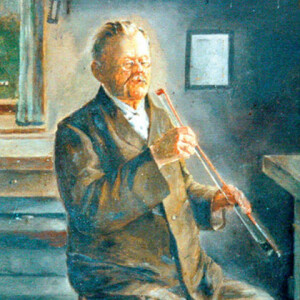
Franz Albert’s father (Franz Albert I, 1826–1894) joined his father Carl Gottlieb in the business and succeeded him after his death. He hired several employees, and together they produced a large number of bows, which they exported to Eastern Europe, Russia, and later to America, where the New York firm Wurlitzer represented him. In the 1906 catalog, Rudolph Wurlitzer referred to him as “the greatest modern bow maker.” Wurlitzer was a highly respected expert in this field and owned an important collection of bows by, among others, Tourte, Peccatte, and Kittel. His opinion of Nürnberger’s work undoubtedly contributed to his success in America. Like his father, Franz Albert supplied not only stamped bows but also unstamped ones. As a result, these were sold under a different name.
German bows were based on a tradition of their own that enjoyed a good reputation among musicians of all levels in Europe and could rival the French tradition. This tradition underwent a shift when Pfretzschner, a bow maker originally from Markneukirchen, returned in 1879 from his stay in Paris. He had worked for Vuillaume and Voirin and brought the French influence back with him. And since French bows had become fashionable throughout Europe, that trend also took hold among the Nürnberger family. Gradually, the Bohemian-Saxon bow-making tradition faded away among them as well.
For Weichhold, they made a number of sticks bearing the brand name “Imitation du Tourte”
The French influence wasn’t entirely new. Richard Weichold had previously made a good replica of a French Tourte stick, but had limited himself to just one; Pfretzschner made many. The Nürnberger family was not far behind. Franz Albert II, and later his son Carl as well, made a large number of precise Tourte replicas, but did not brand them. Both gave the bows an aged appearance, which led others to later sell them as genuine “Tourte bows.” They also supplied other German bow makers; for example, they made a number of bows for Weichhold bearing the brand mark “Imitation du Tourte.”
It was in the family tradition for Franz Albert II to join his father in the business. His father, who had been elected president of the Markneukirchen bowmakers’ guild, had wielded considerable influence. Franz Albert II succeeded him in that role, but nevertheless devoted most of his time to improving the bows.
Phillipp Paul was born in 1882, and Carl Albert three years later. Nürnberger’s bows gradually gained worldwide fame, especially after the company began branding its bows around 1890. His father, Franz Albert I, also worked in the business. Franz Albert I passed away in 1894, and Franz Albert II inherited the family workshop, where he trained his two sons. In addition to French bows, the workshop also produced copies of English bows.
Under the watchful eye of Franz Albert II, his sons developed a new variant, also based on the Tourte. They sold that model under their own name. Around 1920, when the company was at its peak, it even became Carl’s trademark.
Franz Albert II is considered one of the best German cane makers of his time.
German and, in most cases, French cane makers finished the cane with shellac and alcohol. The Nuremberg makers adopted the technique used by early French baton makers of treating the wood with linseed oil. This penetrated deeply into the wood and gave the baton a soft sheen rather than a glossy appearance.

In his heyday, Franz Albert II also made many bows with a tortoiseshell ferrule and a silver or gold rosette on either end, as some Parisian bowmakers did.
The wood he used was of excellent quality, carefully crafted into a bow with good balance. Eugène Ysaÿe, Jan Kubelík, Fritz Kreisler, and David Oistrakh each owned a bow made by Franz Albert II.
Virtually all cane makers in the family whose names included “Albert”—including Franz Albert II—used the brand “Albert Nürnberger.” Canes bearing this brand can be attributed to their maker only by very subtle characteristics.
German bowmaking of the 19th and beginning of the 20th centuries, 1992, Klaus Grunke, Chicago
Zoebisch, B., 2000, Voigtlander Bows; Biographies and Explanations.
Tarisio, Cozio Archive, accessed 2023
Britannica Archive, accessed in 2023
Geneanet, accessed in 2023

