Instrument
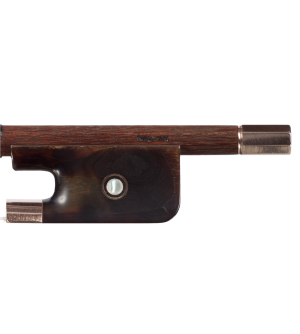
cello bow
Daniel ter Berg
The Hague (?),
± 1975
played by
Rachel Daniels
Rachel Daniels

*1950 , Saint-Maur-des-Fossés †1983 , Amsterdam
He successfully completed his violin-making training after three years, but by that time he had already developed a deep fascination with bows. That is why he decided to shift his career from violin making to bow making. And because Daniel was a perfectionist, he sought an apprenticeship with one of France’s finest bow makers. That mentor was Bernard Millant in Paris. Millant was a passionate, engaging craftsman who made exquisite bows and possessed an almost encyclopedic knowledge of the French luthier tradition, which he generously shared with his employees. Many well-known bow makers had already been trained by him.
This was the period when Millant’s finest bows featured tortoiseshell mounts with gold accents and were inlaid with gold lilies.
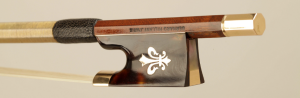
Photo courtesy of Tarisio
Daniel joined Millant at the end of what experts consider to be his finest period, during which he was honored with several gold medals for his bows and violins. It was the period when Millant’s finest bows featured a tortoiseshell mount with gold and were inlaid with gold lilies. Daniel began working at Millant in 1970 as an apprentice bow maker. He remained there until he felt skilled enough to take the next step.
That moment came in 1973 when he left for Morizot in Mirecourt. There he found a workshop in the twilight of a long and illustrious history. In its heyday, the workshop had produced very high-quality bows, but even before Daniel’s arrival, the Morizots had become more focused on an economical production process than on crafting refined bows. After 1970, the workshop was only partially operational. Daniel left when the workshop closed its doors for good.
Daniel was not only a perfectionist, but also forward-thinking. He had found Morizot’s work lacking in refinement, but their working techniques had appealed to him. Sigfried Finkel in Switzerland had successfully balanced those characteristics in his studio; he still worked in a traditional and refined manner, but combined that with modern techniques for pre-processing the raw sticks. Daniel studied this method extensively with Finkel and honed his own skills there until he moved to Amsterdam in 1973.
Daniel’s strong personality did not fit well into Möller’s dynamic studio.
That year, he joined Guillaume Max Möller’s workshop in Amsterdam, which was highly regarded internationally. Wherever he went, Daniel stood out for his knowledge, dedication, and passion, but he was also somewhat eccentric and direct in his manner. Möller’s workshop employed outstanding violin makers and bow makers, but Daniel’s strong personality found little connection or recognition in Möller’s dynamic workshop; he was unable to settle in and left after a year.
He did find that connection around 1974 in Willem Bouman’s workshop in The Hague. There, he felt right at home and worked on bows with his characteristic passion. Daniel possessed an almost genius-level knowledge of his field and was able to recognize violin and bow makers at a glance. Aided by his exceptional visual memory, he was also able to create perfect copies of bows. Over the years, he not only made bows for Bouman but also built up a modest body of his own work, which was diverse and interesting. Some of his later bows found their way directly to renowned musicians, while others were made on commission. Later, several musicians for whom Daniel had made a bow spoke highly of his work, such as the violinist Theo Olof in one of his interviews, as well as the cellist Mstislav Rostropovich and the violist Nobuko Imai. Daniel ter Berg remained with Bouman until a few years before his death. After that, he worked independently. Daniel died in 1983.
During his short life—he was only 33 years old—Daniel ter Berg crafted a number of excellent modern bows. Many Baroque bows made by him are also known. The style and quality of his early work were still somewhat inconsistent, but unfortunately, he passed away before he had developed his definitive style. During the last 10 years of his life, Daniel ter Berg crafted bows for and in collaboration with Willem Bouman. These bows are all stamped with Bouman’s name. He stamped his own bows with “D ter Berg,” sometimes supplemented with “tB” beneath and/or on the ferrule. Particularly in his later years, these included bows with tortoiseshell and gold mounts.
After Daniel’s death, the Musical Instrument Fund received a large portion of the bows from his estate from his heirs. Some of these bows were not yet ready to be played or were unsuitable for loan. These are being kept in the archive for further study. The Fund has included Daniel’s high-quality bows in its collection. You can find out on the website who is currently playing with his bows.
Catalog of the Exhibition of Dutch Musical Instrument Makers, 1982, Zutphen.
Millant, B., Raffin, J.F., 2000, *L'Archet: French Bowmakers, 1750–1950*. Paris.
Conversations with Ms. M.A.W. Frances, Aug. 2019, and with Feiko and Lies Bouman, Sept. 2019.


