Instrument

violin
Carlo Ferdinando Landolfi
Milan,
1755
played by
Ernst Jan Vos
Ernst Jan Vos

*1714 , Baveno †± 1787 , Milaan
Carlo Ferdinando Landolfi was born in Baveno, 75 km northwest of Milan, a town where there were no violin makers of any renown in the surrounding area. We do not know what he did until he was forty, but even before coming to Milan, he had already learned to build stringed instruments in a manner very similar to the Cremonese style. Some experts believe they can see the influence of the young Pietro II Guarneri in Landolfi’s work. The influence of German violin making is also unmistakably present in his work. This could indicate that he apprenticed with one of the many German violin makers in southern Piedmont. Around 1729, he married, and a year later his son, Pietro Antonio, was born (1730–1795).
Until 1749, the region around Milan had been the scene of battles between the armies of the French and Spanish rulers and the advancing Austrian army. The city had become isolated, economically ravaged, and weakened. Little remained of the proud Grancino family of violin makers—founders of the Milanese school—and of their successors, the first generation of the Testore family. In 1901, Hill was not exactly complimentary about the Milanese violin makers of that time: “...they were just cheap-jacks,” which essentially meant that “violin makers from Milan produced instruments of inferior quality.” After peace had returned to the region, Landolfi went to Milan.
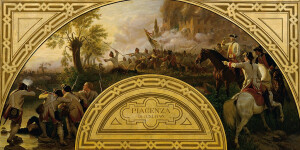
The Battle of Piacenza, Karl von Blaas
Giovanni Battista Guadagnini of Piacenza had just settled there. Near Piacenza, which lay slightly southeast of Milan, a battle had raged shortly before, leaving more than 17,000 wounded. Lorenzo Guadagnini (1685–1746) and his son Giovanni Battista (1711–1786), one of the greatest violin makers of the eighteenth century, worked in the city. For Giovanni Battista, the constant skirmishes were likely the reason he began to travel. In his hometown, he had spent nine years building excellent violins and developing a personal style. His father had worked for Antonio Stradivari and passed on his knowledge to him. In 1948, Hill wrote to Max Möller about Lorenzo and Giovanni Guadagnini, stating that the violin he had seen made by them was one of the finest examples he had ever encountered. When the war ended in 1749 and the new rulers under Maria Theresa of Austria granted Milan a great deal of freedom, G.B. Guadagnini moved there, followed a few months later by Carlo Ferdinando Landolfi.
Landolfi settled near Guadagnini, but is believed to have worked for Paolo Antonio Testore for some time. Testore, however, was a sloppy luthier. Experts of the time spoke rather disparagingly of his work. Paolo’s hastily constructed instruments, made from cheap materials, did not align with Landolfi’s principles. Consequently, he adopted virtually nothing from him.

Image from K. Jalovec, *Italian Violin Makers*, New York, 1958
His time with Testore did not last long. He opened his own workshop near Via Santa Margherita and named it “al Segno della Sirena.” It probably wasn’t a place of true serenity, since it was located in the busiest part of the city. His son, Pietro Antonio, became an apprentice at Testore’s workshop.
Under the previous Maestros di Cappella, Milan Cathedral had become a place where string instruments had come to play an important role in church music. Although church music still held an important place in musical life, a growing number of small ensembles of secular amateur musicians had also emerged in Milan, which had developed into orchestras and performed at a high level. As a result, the demand for high-quality violins and cellos increased sharply. It was the violins and cellos made by Landolfi and Guadagnini that better met the demand for high-quality instruments than those made by Paolo Testore.
Landolfi must have looked up to Giovanni Battista Guadagnini. Guadagnini was a simple, rough-hewn man, but one with a wealth of experience that still echoed his father’s craftsmanship from the time he worked for Stradivari. They presumably knew each other well, and Guadagnini certainly influenced Landolfi, but together they also adopted elements from other makers. For example, in 1755, they both suddenly began using a thick, glossy red varnish. A larger template for violins and cellos than was customary in Milan also made its simultaneous debut with both makers. After working in Milan for eight years, Guadagnini left. From that point on, Landolfi became Milan’s most important luthier and was regarded as the head of the city’s guild of violin makers.
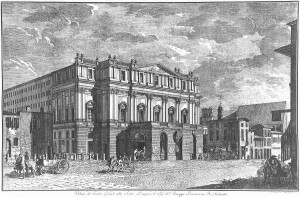
La Scala Theater
In the final years of his life, Landolfi saw the city come to life. The city gained an academy of fine arts and sciences, but the highlight was undoubtedly the construction of the Teatro alla Scala in 1778, with over 3,000 seats. It was located on Via Santa Margherita, just a stone’s throw from his studio. Thanks to “la Scala,” large numbers of Italy’s finest musicians were drawn to the city. Milan suddenly became one of Italy’s leading opera cities.
Landolfi was a hard worker; his body of work was therefore presumably quite extensive. The exact number is unknown, as countless forgeries appeared on the market in the nineteenth century.
From 1755 to 1760, Pietro Giovanni Mantegazza (c. 1730–1803) was his apprentice and assistant. Carlo Ferdinando Landolfi died in 1787. His son Pietro took over the workshop. However, Pietro’s skill did not even come close to that of his father. His instruments were exported on a large scale to England and America. Carlo Ferdinando Landolfi is considered the most important Milanese luthier of the eighteenth century.

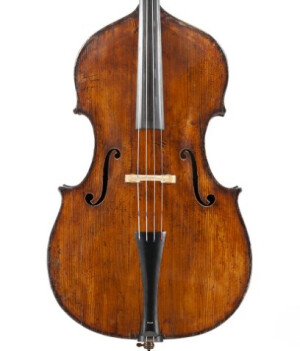
(Rare) double bass from the collection of the Musical Instrument Fund
The earliest known instruments by Landolfi feature a high arch. This allowed him to increase the volume, but in terms of design, he largely adhered to the dimensions of the Cremonese masters. In doing so, he diverged from the Milanese school of Giovanni Grancino (1637–1709) and his followers. In his early years, his work was not yet very consistent. In addition to the influences of Guadagnini, those of Stainer can still be seen in his work for some time. Landolfi had distanced himself from Paolo Antonio Testore (1700–1767) almost immediately. He did, however, adopt the distinctly finished edges, as Paolo’s father had made them.
As early as 1752, he had already achieved a very impressive level of craftsmanship with a violin he built that year; it was superbly constructed, meticulously finished, and featured a magnificent varnish. Guadagnini’s influence remained clearly visible in Landolfi’s work even after Guadagnini’s departure from Milan. He further perfected his craftsmanship and worked exclusively with the finest materials he could find. Starting in 1765, the C-curves became more elongated and the arches less pronounced. He no longer used the thickly applied red varnish, but opted for a bright orange-yellow color.
For his cellos, he used a smaller model than was customary at the time. He managed to maintain his high standard of work well into old age; it was not until around 1775 that his work began to show the first signs of decline. The scroll was crafted with less precision, and the edge inlay also became less precise. Landolfi built mainly violins and a small number of violas and cellos. He also built a few large-sized double basses, of which only two still exist. One of these two rare basses is owned by the Musical Instrument Fund.
The Works of Giovanni Battista Guadagnini, 1999, Cremona.
Chiesa C., 1996, Violinmakers at the Contrada Larga in Milan.
Kass P. J., 1989, Stringed Instruments by the Milanese Violin Makers of the Contrada Larga.
Santoro, E., 1989, Violin Makers and Violins, Cremona.
Blot, E., Italian Violin Making IV - Piedmont, 2001,
Tarisio, Cozio Archive, accessed 2020
Instituto Treccani, visited in 2020

